Key takeaways
- Promise clarity means your thumbnail and title say exactly what the viewer will see — no exaggeration, no ambiguity.
- A simple pre-publish test: ask yourself if the viewer will feel tricked after the first 30 seconds.
- Over-promising doesn’t hurt your morality — it hurts retention, because viewers leave fast when reality doesn’t match.
- A clear promise isn’t always clickbaity — but it attracts the right viewers, not just the curious.
- A clearer promise doesn’t guarantee more views — it improves traffic quality and long-term loyalty.
How to know if your YouTube packaging over-promises
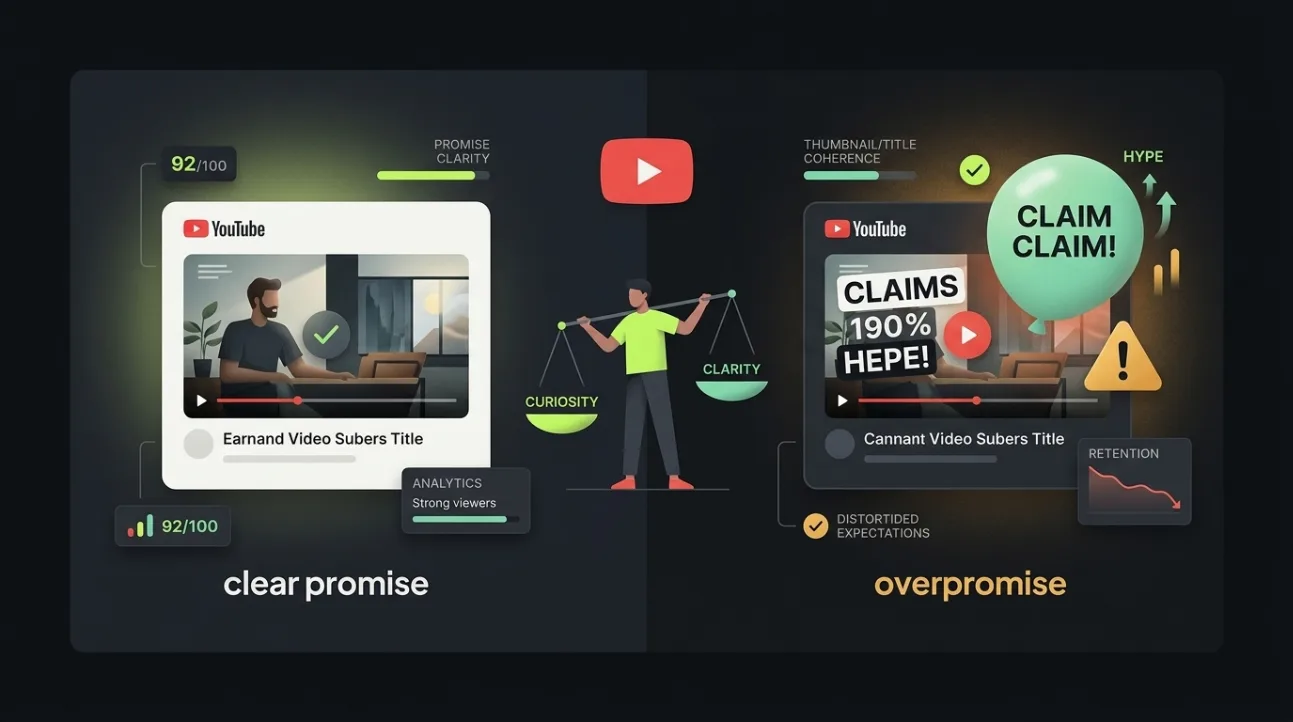
Promise clarity on YouTube means your thumbnail and title accurately describe what the viewer will experience in the first 30 seconds — no exaggeration, no misleading implication, no unmet expectation. It’s a visual and textual promise you keep — or break. If the viewer feels tricked after clicking, you’ve over-promised — and that costs you in retention, not moral reputation.
Many creators confuse “clickable” with “deceptive.” A thumbnail screaming “YOU’LL NEVER SEE THIS!” or a title promising “THE SECRET NO ONE TELLS YOU” creates artificial anticipation. When the content doesn’t deliver, the viewer leaves — and YouTube logs that drop-off rate. It’s not an ethics issue — it’s a performance issue. The system doesn’t punish bad faith — it punishes poor retention rates.
Clarity isn’t the enemy of engagement. It’s its foundation. A viewer who knows exactly what to expect is more likely to stay — even if the content is simple. A viewer who feels tricked, even if intrigued, leaves as soon as they realize they’ve been manipulated.
A simple test to check your promise clarity before publishing
Before publishing, ask yourself: “If a viewer watches the first 30 seconds, will they feel I kept my promise?” If the answer is no, you’re over-promising — even if you didn’t lie. Ambiguity is as dangerous as exaggeration. A title like “I’ll show you how to earn €1000 in 24h” promises a concrete result — but if the video only discusses “long-term strategies,” you’ve broken trust.
Here’s a procedure to follow before every upload:
- Look at your thumbnail and title as if you’re a random viewer — with no knowledge of the content.
- Write down what you expect from the video in 10 words or less.
- Watch the first 30 seconds of the video — without sound.
- Compare what you expected with what you saw.
- If they don’t match, revise your packaging — not your content.
This test is repeatable, objective, and doesn’t depend on your intent. It depends on the viewer’s perception — and that’s what YouTube measures. You can also ask a friend to run the test for you: if they don’t understand what the video will show, your promise isn’t clear.
Real example: a deceptive thumbnail vs. an honest one
Imagine a video titled “How to create a logo in Canva in 5 minutes.” The over-promising version uses a thumbnail with a shocked face, bold text “INCREDIBLE!”, and a bright red background — as if the logo were a millionaire’s secret. The title says: “The logo no one shows you — you’ll love it!” The viewer clicks expecting a secret tool or magic trick. In reality, it’s a basic tutorial — and the viewer leaves in 20 seconds.
The corrected version uses a thumbnail showing the Canva interface, a simple logo in progress, and clear text: “Create a logo in 5 min — step-by-step tutorial.” The title is identical. The viewer knows exactly what to expect — and stays because that’s precisely what they’re looking for. Retention is higher, even if CTR is slightly lower. Quality traffic beats quantity.
Here’s a comparison table of the two approaches:
| Element | Over-Promising Version | Clear Version |
|---|---|---|
| Thumbnail | Shocked face, exaggerated text, loud colors | Canva interface, logo in progress, neutral text |
| Title | “The logo no one shows you — you’ll love it!” | “Create a logo in 5 min — step-by-step tutorial” |
| Viewer Expectation | A secret revelation, spectacular result | A simple, fast, applicable tutorial |
| Impact on Retention | Sharp drop after 20 seconds | Stable or rising during first 2 minutes |
The clear version doesn’t “sell” better — but it retains better. And that’s what YouTube rewards.
Why over-promising costs you in retention — not morality
Over-promising isn’t a moral issue — it’s a performance issue. When a viewer clicks on a deceptive thumbnail, they don’t feel “betrayed” — they feel “lost.” They leave because the content doesn’t match their expectation, not because they resent you. And YouTube logs that departure as a negative signal. The more you over-promise, the more your retention rate drops — and the more your video gets penalized in recommendations.
The system doesn’t judge your intent — it judges the viewer’s experience. If 70% of viewers leave before the minute mark, YouTube understands your content doesn’t retain — even if you didn’t lie. Promise clarity isn’t a virtue — it’s a strategy. It aligns expectation with reality, reducing drop-offs. And less drop-off = more recommendations = more views long-term.
Retention isn’t an indicator of quality — it’s an indicator of relevance. A viewer who stays isn’t necessarily satisfied — but they’re at least engaged. And that’s what the system values.
Clarity vs. clickability: why a clear promise isn’t always catchy
A clear promise isn’t always catchy — and that’s not a problem. A thumbnail saying “How to repair an iPhone 14” is clear, but it doesn’t scream “YOU’LL NEVER SEE THIS!” It attracts viewers who are specifically looking for that — not the curious. And that’s exactly what you want: viewers who stay because they found what they were searching for.
A vague promise, on the other hand, attracts viewers who don’t know what they want — and who leave as soon as they realize they’ve been tricked. CTR may be higher, but retention will be lower. And it’s retention that matters to YouTube — not CTR.
Clarity isn’t the enemy of engagement — it’s its foundation. A viewer who understands exactly what they’ll see is more likely to stay — even if the content is simple. A viewer who feels tricked, even if intrigued, leaves as soon as they realize they’ve been manipulated.
A clearer promise doesn’t guarantee more views — but it improves traffic quality
It’s crucial to understand: a clearer promise doesn’t guarantee more views. It guarantees better traffic quality — and better retention. You might get fewer clicks, but more viewers who stay — and that’s what YouTube rewards. The system doesn’t aim to maximize clicks — it aims to maximize engagement.
If you fix your packaging to make it clearer, don’t expect a surge in views. Expect higher retention, lower drop-off, and better long-term recommendations. It’s a slow, durable gain — not a fast, fragile one.
And if you want to check your packaging clarity before publishing, try ThumbSignal’s free Thumbnail & Title Analysis tool — it gives you a clarity score and concrete suggestions to improve your promise.
Related reading
- How to Use the Cliffhanger Effect to Boost YouTube Retention
- vidIQ Thumbnail Tool Alternative: Analyze Your Existing Thumbnail
Frequently Asked Questions
What is promise clarity on YouTube?
Promise clarity means your thumbnail and title accurately describe what the viewer will experience in the first 30 seconds — no exaggeration, no ambiguity. It’s a visual and textual promise you keep — or break.
Why does over-promising cost you in retention?
Because viewers leave quickly when reality doesn’t match — and YouTube logs that departure as a negative signal. The more you over-promise, the more your retention rate drops — and the more your video gets penalized in recommendations.
How do I test my promise clarity before publishing?
Look at your thumbnail and title as if you’re a random viewer — with no knowledge of the content. Write down what you expect from the video in 10 words or less. Watch the first 30 seconds — without sound. If they don’t match, revise your packaging.
Is a clear promise always catchy?
No — a clear promise isn’t always catchy, but it attracts the right viewers, not just the curious. And that’s what matters for retention and long-term recommendations.
Does a clearer promise guarantee more views?
No — a clearer promise doesn’t guarantee more views. It improves traffic quality and retention — which leads to better long-term recommendations, but not an immediate boost in views.