
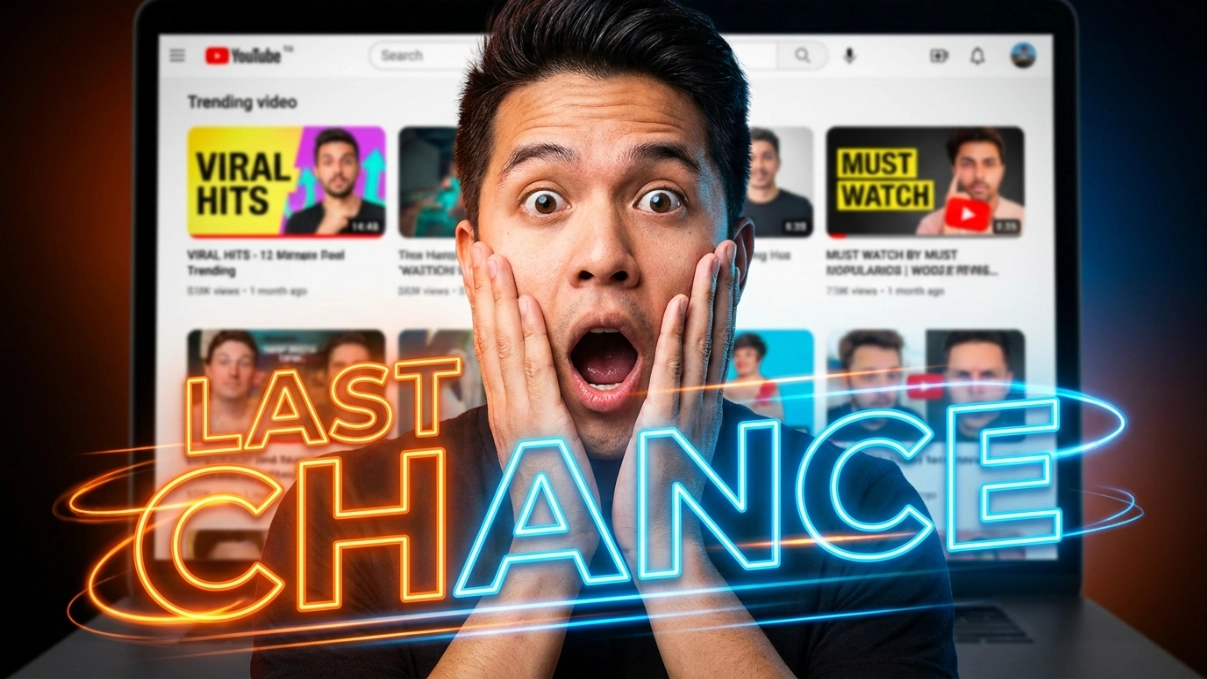
Thumbnail advice often says that fear of missing out raises click-through rates: add a countdown, write “last chance”, and viewers will click before it is too late. We looked for evidence behind that claim and did not find any. This article sets out what is actually known about FOMO, why the research on scarcity does not transfer to a free video, and when a time limit in a thumbnail is honest information rather than a trigger.
Key takeaways
- We found no study showing that FOMO in a thumbnail or title raises clicks. Fear of missing out is studied as a trait of social-media users, not as something packaging can switch on.
- Scarcity messages raise purchase intention for products that genuinely run out. A free video does not run out, and there is no evidence the effect carries over to clicks.
- When a video really is tied to a deadline, such as an event that ends tonight, saying so is information the viewer can use. Inventing one is a promise the video cannot keep.
- The best evidence on real clicks points elsewhere: a concrete outcome with the method held back, and wording whose tone matches the video.
- To compare a time-sensitive thumbnail with a neutral one, use YouTube’s Test & compare on the same video, not two uploads. YouTube picks the winner on watch time, not on clicks.
Does FOMO in a YouTube thumbnail increase CTR?
Not on any evidence we could find. The claim usually rests on two borrowed ideas: that fear of missing out drives behaviour, and that scarcity makes people act. Both come from research that measured something other than clicks on a video.
Fear of missing out was defined and measured by Przybylski and colleagues in 2013 as a personal trait: the apprehension that others are having rewarding experiences without you, which goes with heavier social-media use. That research describes people, not headlines. We found no study that varied a title or thumbnail to make it more or less “FOMO” and counted the clicks.
Absence of evidence is not proof that FOMO never works. It means that an article telling you FOMO thumbnails increase CTR is stating something no one has shown, and an earlier version of this article did exactly that.
Why scarcity research does not carry over to a free video
Scarcity is the strongest-sounding part of the FOMO argument, and the research behind it is real. A 2023 meta-analysis by Ladeira and colleagues pooled studies of product scarcity and found that messages such as “limited stock” or “offer ends soon” raise the intention to buy. The conditions matter, though: a product that can genuinely run out, and a decision to spend money.
A YouTube video meets neither condition. It will usually still be there tomorrow, and watching it costs nothing but time. A countdown or “last chance” on a video borrows the language of scarcity research without its conditions. No study we found shows that the effect survives the move from a shop to a feed.
A number in a title is a different thing. “I tried it for 30 days” makes the promise specific; it does not create urgency. On real headline tests, a headline with a digit won 55.8% of the pairs we compared, and 60.9% of the pairs with a clear winner. That is concreteness doing the work, not fear.
What our own scores showed
ThumbSignal’s score rates FOMO and urgency as two of its twelve factors, so we checked how they behaved on real videos. In our test of 321 pairs of videos from the same channel, the FOMO rating averaged 64.8 on the video that beat its channel’s average and 60.7 on the one that fell short, a small difference (an effect size of 0.30). The urgency rating showed a similar, smaller gap.
That looks like support until you see how the ratings move together. Across the 642 videos in that test, FOMO correlated with curiosity, cliffhanger and the withheld-answer rating at between 0.73 and 0.88. In practice the four ratings measure one quality, roughly how much the packaging leaves open, under four names. The data says that packaging which leaves something open did slightly better. It does not say that fear did.
We changed the score accordingly on 4 October 2026. A dramatic transformation no longer earns a minimum FOMO rating, a duration counts as specificity rather than urgency, and the suggested titles never invent urgency, scarcity or a crowd. The full reasoning is in our review of the evidence on click triggers.
When a time limit in a thumbnail is honest
Some videos really are tied to a date: a game event that ends tonight, a sale with an end date, a deadline to apply, a live announcement. For those, saying when it ends is not a trick. It tells the viewer something true that affects whether the video is useful to them, and a viewer who clicks gets what was promised.
The test is simple: would the statement still be true after the click? “Event ends Sunday” on a video about that event passes. “Last chance” on a tutorial that will be just as useful next year fails, and so does “before it’s deleted” on a video you have no plan to delete. A viewer who notices the gap has learned that your packaging exaggerates, and that lesson carries over to your next video.
- Name the real limit, with its date or time, rather than a vague “hurry”.
- Make the limit part of the subject, not a badge added on top: the event, the offer, the deadline.
- Leave it out of evergreen videos entirely. A clear statement of what the viewer will get serves them better.
What to use instead of manufactured urgency
The research that did measure real clicks points to two things, and neither is fear.
The first is concreteness. A registered report by Aubin Le Quéré and Matias, published in 2025, analysed 8,977 randomized headline tests and found that clicks peak at a middle level of concreteness: a headline that is too vague loses, and so does one that gives everything away. In practice that means stating the outcome and holding back how it was reached. “I cut my editing time in half” with the method left for the video sits in that middle ground.
The second is tone. Robertson and colleagues analysed more than 100,000 headline variants from real tests and found that each negative word raised clicks by about 2.3% for an average headline, while each positive word lowered them by about 1%. That is a modest effect, and it only helps when the tone is true of the video: a worried title on a calm tutorial sets up a disappointment.
Controlled studies of clickbait point the same way. Molina and colleagues found that clickbait headlines did not reliably attract more clicks than plain ones, and Scacco and Muddiman found that curiosity-style headlines did not outperform straightforward ones either.
How to test a time-sensitive thumbnail against a neutral one
If you want to know whether naming a deadline helps on your channel, test it on the same video. YouTube Studio’s Test & compare lets eligible long-form videos try up to three thumbnails or titles, shows them to different viewers, and picks the winner on watch time rather than click-through rate. Shorts cannot be tested this way, and a test can take up to about two weeks.
That last point matters here. A thumbnail that names a deadline is only honest until the deadline passes, so a test that runs past it compares an honest thumbnail with an expired one. For short-lived events, decide on the honest version and skip the test.
Do not compare two separate uploads of the same video, or two different videos, and call it a test. Their audiences, timing and recommendations differ in ways you cannot see, so the difference tells you little about the thumbnail. Before you publish, you can also score your thumbnail and title; the urgency and FOMO factors will tell you how strongly the packaging leans on them, and promise clarity will tell you whether the promise is still clear.
Correction, 16 October 2026. An earlier version of this article said that FOMO in thumbnails increases click-through rates and that scarcity and social proof are proven motivators for clicks. We found no study supporting either claim for videos. The article has been rewritten from the sources below.
Sources
- Przybylski, A., Murayama, K., DeHaan, C. and Gladwell, V. (2013). Motivational, emotional, and behavioral correlates of fear of missing out. Computers in Human Behavior, 29(4), 1841–1848. doi:10.1016/j.chb.2013.02.014
- Ladeira, W., Lim, W., de Oliveira Santini, F., Rasul, T., Perin, M. and Altinay, L. (2023). A meta-analysis on the effects of product scarcity. Psychology & Marketing, 40, 1267–1279. doi:10.1002/mar.21816
- Robertson, C., Pröllochs, N., Schwarzenegger, K., Pärnamets, P., Van Bavel, J. and Feuerriegel, S. (2023). Negativity drives online news consumption. Nature Human Behaviour, 7, 812–822. doi:10.1038/s41562-023-01538-4
- Aubin Le Quéré, M. and Matias, J. N. (2025). When curiosity gaps backfire: effects of headline concreteness on information selection decisions. Scientific Reports, 15, 994. doi:10.1038/s41598-024-81575-9
- Molina, M. D., Sundar, S. S., Rony, M., Hassan, N., Le, T. and Lee, D. (2021). Does clickbait actually attract more clicks? Three clickbait studies you must read. Proceedings of CHI 2021. doi:10.1145/3411764.3445753
- Scacco, J. and Muddiman, A. (2020). The curiosity effect: Information seeking in the contemporary news environment. New Media & Society, 22, 429–448. doi:10.1177/1461444819863408
- YouTube Help. A/B test titles and thumbnails (Test & compare). support.google.com/youtube/answer/13861714
- ThumbSignal. Method and evidence page for the 321-pair test, and our test of title rules against real clicks for the digit figures.
Frequently Asked Questions
Does FOMO increase CTR on YouTube?
We found no study showing it. Fear of missing out has been studied as a trait of social-media users, not as a property of a title or thumbnail that changes clicks. It may help in some cases, but no one we could find has shown that it does.
Do countdowns and “last chance” labels work on thumbnails?
Scarcity messages raise purchase intention when something genuinely runs out, which a free video usually does not. There is no evidence the effect carries over to clicks, and a false deadline is a promise the video cannot keep. Name a real limit when there is one, with its date.
When is it fine to show urgency in a thumbnail?
When the video is genuinely tied to a deadline: an event that ends, an offer with an end date, an application window. Then the limit is information the viewer can use. If the statement would no longer be true after the click, leave it out.
What works better than FOMO for clicks?
On real headline tests, a concrete outcome with the method held back, a digit when the content has a number, and a tone that matches the video. These effects are modest, so treat them as habits to test on your channel, not guarantees.
How do I test whether urgency helps on my channel?
Use YouTube Studio’s Test & compare on the same video, if your channel has it. It shows up to three versions to different viewers and picks the winner on watch time. Skip the test for short-lived events, where the deadline may pass before the test ends.