
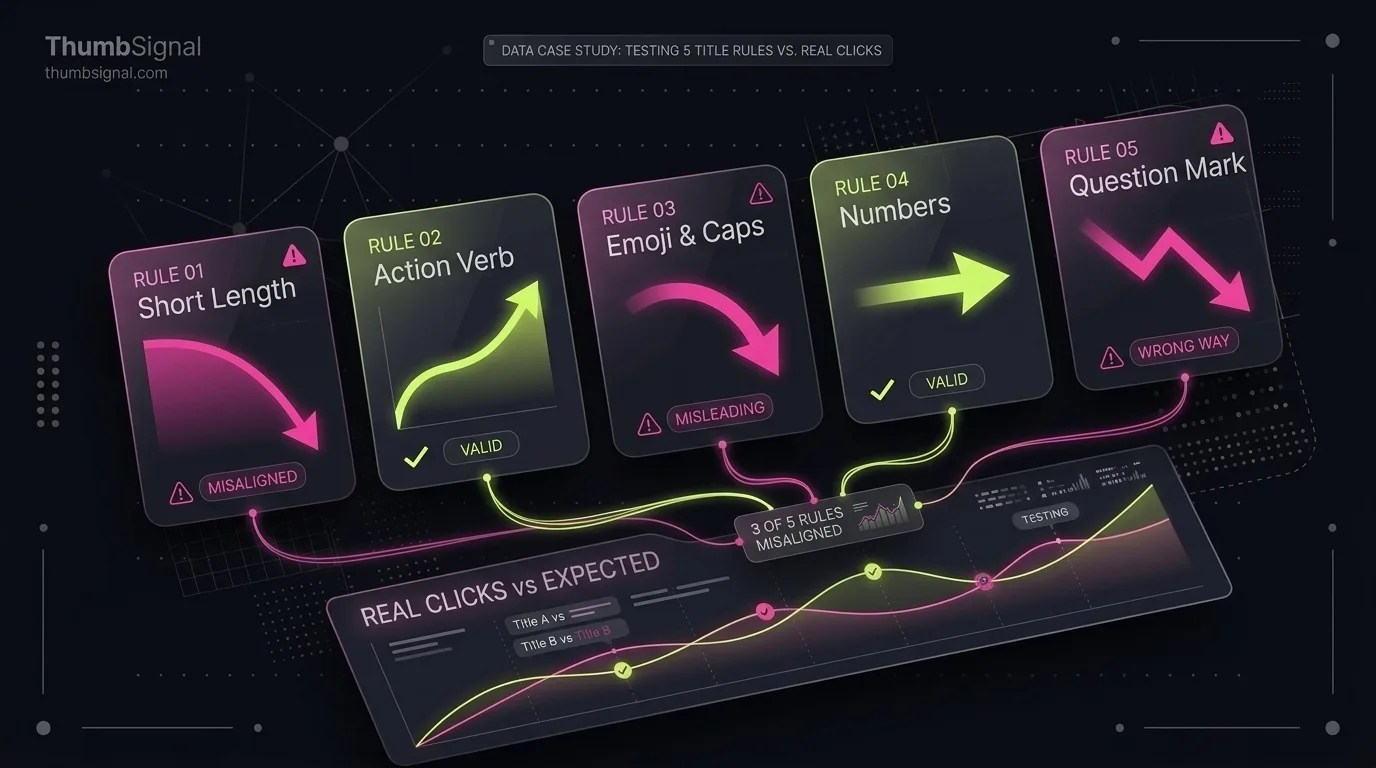
Three of the title rules our score used to apply turned out to point the wrong way. We checked them against real clicks from nearly two thousand randomized headline tests: the bonus for a question mark, the bonus for a title of 40 to 70 characters and the bonus for 4 to 10 words all favoured the headline that lost more often than the one that won. We removed all three on 4 October 2026.
Key takeaways
- We compared 17,236 pairs of headlines that ran against each other on the same image, with readers assigned at random, and looked at which one got more clicks.
- The headline with a question mark won only 42.3% of its pairs, and 33.8% of the pairs where the difference in clicks was clear.
- Rewarding 40 to 70 characters, or 4 to 10 words, picked the loser more often than the winner. Longer headlines and headlines with more words actually won slightly more often.
- A digit in the headline was the simplest feature that helped: 55.8% of all pairs, 60.9% of the clear ones.
- These are news headlines from 2013 to 2015, not YouTube titles. On our own YouTube sample, removing the three rules did no harm, which is a weaker claim than "it helps".
Do question marks and an ideal length make a YouTube title better?
Not on the evidence we could find. On real headline tests, a question mark was a sign of the weaker headline, and a length or word count inside the commonly recommended window was not a sign of the stronger one. What did help was concrete: a number, or a list format, when the content really has one.
We went looking because our own score rewarded all three. A title earned extra points for ending in a question, for landing between 40 and 70 characters and for using 4 to 10 words. Those rules came from the same advice every creator has read, and no one had checked them against what readers actually clicked.
Where the real clicks come from
YouTube does not publish click-through rates per title, and comparing titles across channels mostly measures the channels. The closest public evidence to a fair title test is the Upworthy Research Archive, released by Matias and colleagues in 2021 under an open licence. It holds 32,487 experiments that a news and stories site ran between 2013 and 2015: several headlines for one story, shown at random to real readers, with the clicks counted for each.
How we built the pairs
We used the archive's exploratory file only. The confirmatory and holdout files are reserved for registered studies, so we did not open them. We dropped every test created between 25 June 2013 and 10 January 2014, a window in which the archive's authors found a randomization defect, and every version shown fewer than 1,000 times.
Then we paired versions inside each test that used the same image and a different headline, so the headline was the only thing that changed. That left 18,375 versions in 1,996 tests, which gave 17,236 pairs. In 4,774 of them, the difference in click-through was clear at the usual statistical threshold (p < 0.05). The median winner beat its loser by 36% in relative click-through, so these are not rounding errors.
What we ran against them
We ran our production rule classes on every headline without changing a line, and asked a simple question of each pair: did the rule give the higher score to the headline that got more clicks? Beside them we put trivial baselines, such as "the longer headline wins", to see whether the rules beat a feature anyone could count. A rule that knows nothing scores about 50%. A rule below 50% is not merely useless: it is pointing at the loser.
What the clicks said about each rule
The table gives the share of pairs in which each predictor picked the headline that got more clicks. The first column covers every pair, the second only the pairs with a clear winner.
| Predictor | All pairs | Pairs with a clear winner |
|---|---|---|
| Our title-strength rules | 47.2% | 44.7% |
| Our curiosity rules | 46.1% | 43.8% |
| Headline has a question mark | 42.3% | 33.8% |
| Headline gets the 40 to 70 character bonus | 43.8% | 39.1% |
| Headline gets the 4 to 10 word bonus | 41.6% | 37.8% |
| The longer headline | 52.6% | 55.5% |
| The headline with more words | 53.1% | 56.6% |
| Headline contains a digit | 55.8% | 60.9% |
Both of our rule sets sat below chance, and the intervals around them did not reach 50%. Taken one rule at a time, three rules explained most of it. The question-mark bonus was the worst: where the difference was clear, the headline ending in a question lost two pairs out of three.
The length rules failed for a less obvious reason. The bonus rewarded a window, while across all pairs the longer headline won slightly more often than the shorter one. Our rule also penalised headlines above 80 characters, and the penalised headline won 54.5% of its pairs. The rule was not just noisy: it consistently pushed the score toward the shorter, weaker version.
The rules the data did support
A digit in the headline helped, and so did the "N ways, tips or reasons" pattern (62.4% of its pairs, 77.5% of the clear ones) and "what happens" (60.9% and 69.2%), though both of those appeared in few pairs. Power words won 49.2% of their pairs, which is chance. "Why", "secret", "from … to", "transform" and "tested" or "tried" showed no effect either way.
We did not add any of those as new rules. Choosing rules on the same data you then score them on is how a sample's noise becomes a product feature, and the list patterns were too rare to trust on their own.
What changed in our score, and what it did on YouTube
We removed the question-mark bonus, the 40 to 70 character bonus with its over-80 penalty, and the 4 to 10 word bonus. On the headline tests, the title rules went from 47.2% to 52.4% on all pairs and from 45.2% to 55.3% on the clear ones, measured as they enter the overall score. They stopped pointing the wrong way.
Upworthy is not YouTube, so we also replayed the change on the 321 same-channel YouTube video pairs from our published test of the score. The study stored every sub-score, so the overall score could be recomputed without asking the model anything new. The score picked the better-performing video in 61.4% of pairs before the change and 62.6% after. That is four pairs, well inside the noise of about 2.7 points for a sample this size. The honest reading is that removing the rules did no harm on YouTube, not that it improved the score.
The interface changed with it. The title field no longer recommends 40 to 70 characters. It says to put the hook in the first words, because feeds can cut a title after about 60 characters, and that no length scores better by itself.
How to write a title with this in mind
None of this hands you a formula, and a formula is exactly what the failed rules were. What it does give is a short list of habits the evidence does not contradict:
- Put the hook in the first words. Feeds can cut a title after about 60 characters, so the part that decides the click has to survive the cut.
- Do not add a question mark to manufacture curiosity. If the video answers a real question, a plain statement of the stake usually does the same job.
- Use a number when the video has one: a count, a duration, a price, a result. It makes the promise concrete, and concrete was the one thing that kept winning.
- Do not trim a clear title to hit a character target. Length was a weak signal in both directions, and clarity is the part viewers check against the video.
- Write two or three versions and compare them on the same thumbnail, since the title and the image are read together. You can score each version with the same thumbnail and see which factors move.
What this test does not show
The headlines are news and social-cause stories in English from 2013 to 2015, shown on a website that never truncated them. A length rule designed for YouTube's cut-off display is not refuted by a page with no cut-off. What the data does show is that "40 to 70 characters" is not something readers rewarded on its own.
The question-mark result is about headlines, not about a question mark drawn on a thumbnail. And the Upworthy test measured our rule-based half of the title score only: the model's half reads the thumbnail and title together, and no thumbnail is in the archive. The model's own judgement of titles is tested in a separate experiment on the same archive, in our article on whether an AI can predict which title gets more clicks.
Finally, this is our analysis of a public dataset, not a study we pre-registered. The plan, the exclusions and the predictors were fixed before we read any outcome, and the archive is open, so anyone can repeat the pairing. We have not yet published our scripts.
Frequently asked questions
Do question marks in YouTube titles increase clicks?
We found no evidence that they do. In randomized headline tests, the version with a question mark won only 42.3% of its pairs, and a third of the pairs where the difference was clear. These were news headlines rather than YouTube titles, so the safe conclusion is that a question mark is not a click lever on its own.
What is the best length for a YouTube title?
There is no length that scores better by itself. Rewarding 40 to 70 characters picked the losing headline more often than the winner, and longer headlines won slightly more often. On YouTube, the useful constraint is truncation: keep the hook in the first words so it survives when the end is cut.
Do numbers in titles work?
A digit was the simplest feature that helped: the headline with one won 55.8% of all pairs and 60.9% of the clear ones. It helps when the number is real, because it makes the promise concrete. A number invented for the title is a promise the video then has to keep.
Why did ThumbSignal change its title score?
Three of its rules favoured the headline that lost on real clicks. We removed them on 4 October 2026. On our YouTube sample of 321 video pairs the change made no measurable difference, so it corrected a rule that pointed the wrong way rather than making the score more accurate overall.
Is Upworthy data relevant to YouTube?
Partly. It is the closest public evidence to a fair title test, because the same story was shown with different headlines to readers assigned at random. But it is a news site from a decade ago, without YouTube's truncation or thumbnails, so it can refute a rule more convincingly than it can prove a new one.