Key takeaways
- Clickbait promises shock or secret outcomes but often fails to deliver, hurting retention and long-term channel growth.
- Curiosity-driven thumbnails and titles invite viewers with genuine intrigue, matching the video’s actual content and rewarding attention.
- Retention — not just clicks — determines whether YouTube recommends your video, making honest engagement more valuable than short-term tricks.
- Revising clickbait into curiosity-based framing improves viewer satisfaction and builds trust with your audience.
- A pre-publish checklist helps you avoid deceptive practices while still creating compelling, clickable content.
YouTube clickbait vs curiosity: What’s the difference and why retention matters
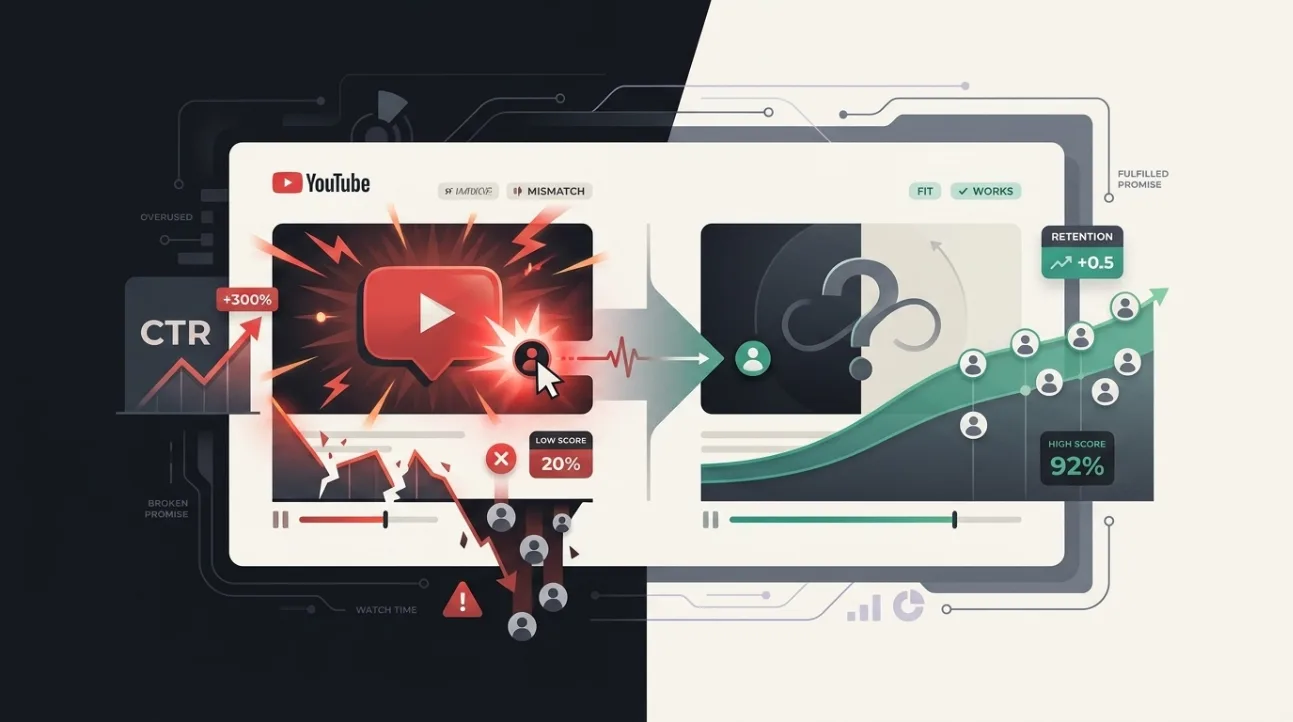
YouTube clickbait tricks viewers into clicking with exaggerated promises, while curiosity-driven content invites them with genuine intrigue — and retention is the metric that reveals which strategy actually works. Clickbait may get initial clicks, but it often leads to early drop-offs, signaling to YouTube that the video isn’t worth recommending. Curiosity, on the other hand, aligns the promise with the payoff, keeping viewers watching longer and building trust over time.
Clickbait and retention: Why short-term clicks backfire
Clickbait and retention are inversely related — the more deceptive the thumbnail or title, the more likely viewers are to leave quickly, which hurts your video’s performance. YouTube’s system prioritizes videos that hold attention, not just those that attract initial clicks. When viewers click expecting one thing and get another, they leave early — and YouTube notices. That drop in retention signals low quality, reducing future recommendations and limiting your reach.
Retention isn’t just a vanity metric — it’s the core signal YouTube uses to decide whether to push your video to more people. A video with high click-through rate (CTR) but low retention will eventually stall, while a video with moderate CTR and strong retention can grow steadily. That’s why creators who focus on honest curiosity outperform those who rely on shock or deception.
Promise, evidence, click, and satisfaction: The four pillars of effective thumbnails
Every effective thumbnail and title must pass four tests: it must make a clear promise, provide visual evidence, invite a click, and deliver satisfaction. Clickbait often fails at evidence and satisfaction — it promises something sensational but offers no visual proof and rarely delivers on the hype. Curiosity-driven content, however, balances all four: it hints at something interesting, shows a real visual cue, invites engagement, and fulfills the promise within the first 30 seconds.
For example, a clickbait thumbnail might show a shocked face with text like “I Can’t Believe This Happened!” — but there’s no context or visual clue. A curiosity-driven version might show a person holding a strange object with text like “Why Did This Break After 3 Days?” — offering a specific, intriguing question with a visual anchor.
Here’s how the four pillars break down:
| Pillar | Clickbait Approach | Curiosity Approach |
|---|---|---|
| Promise | Overstated, vague, or misleading (“You Won’t Believe…”) | Specific, intriguing, and honest (“What Happens When You Try X?”) |
| Evidence | Minimal or fake visual cues (shocked faces, red arrows) | Clear, relevant visuals that hint at the content (objects, actions, expressions) |
| Click | Relies on shock or urgency (“Last Chance!”) | Invites curiosity with open questions or visual puzzles |
| Satisfaction | Often fails to deliver on the promise, leading to drop-offs | Delivers on the promise quickly, rewarding viewer attention |
How to turn clickbait examples into honest-curiosity rewrites
Turning clickbait into curiosity-driven content means replacing vague hype with specific, honest intrigue — keeping the hook but removing the deception. Start by identifying the core promise of the clickbait version, then reframe it to match what the video actually delivers. Use concrete language, visual anchors, and open-ended questions that invite exploration rather than shock.
Here’s a step-by-step process to rewrite clickbait into curiosity:
- Identify the clickbait phrase: Look for vague, exaggerated, or emotionally manipulative language like “You Won’t Believe” or “This Changed Everything.”
- Extract the actual content: What does the video really show? What’s the specific outcome, discovery, or insight?
- Reframe the promise: Turn the hype into a specific, intriguing question or statement that matches the content.
- Add visual evidence: Choose an image or graphic that visually supports the new framing — not just a shocked face or red arrow.
- Test for satisfaction: Ask yourself: “If I clicked this, would I feel rewarded within the first 30 seconds?”
For example, a clickbait title like “I Tried This for 7 Days and You Won’t Believe What Happened!” could become “What Actually Happened When I Tried This for 7 Days?” — keeping the intrigue but removing the false promise. The thumbnail could show a before/after comparison or a specific object from the experiment, giving viewers a real reason to click.
Pre-publish risk checklist: Avoiding clickbait while staying clickable
Before publishing any video, run through this pre-publish risk checklist to ensure your thumbnail and title are curiosity-driven, not deceptive. This helps you avoid short-term tricks that hurt long-term growth while still creating content that attracts attention. Use this checklist as a filter — if any item raises a red flag, revise before publishing.
- Does the title make a specific, honest promise that matches the video’s content?
- Does the thumbnail provide visual evidence of what the video is about — not just a shocked face or red arrow?
- Would a viewer feel satisfied within the first 30 seconds, or would they feel misled?
- Is the click driven by curiosity or by shock, urgency, or false scarcity?
- Does the thumbnail and title work together to tell a mini-story or pose a question?
- Would you click this if you saw it in your feed — and would you keep watching?
Running through this checklist doesn’t mean sacrificing clicks — it means trading short-term deception for long-term trust. Creators who consistently deliver on their promises build loyal audiences that keep coming back, which is what YouTube’s system rewards.
For a quick, automated way to test your thumbnail and title against these principles, try our free thumbnail and title analysis tool — it scores your content on clarity, curiosity, and alignment with viewer expectations.
Related reading
- YouTube Title Optimization: Browse vs Search Strategies That Work
- How FOMO in YouTube Thumbnails Increases CTR
Frequently Asked Questions
Is all clickbait bad for YouTube?
Not all clickbait is inherently bad — but deceptive clickbait that misleads viewers harms retention and long-term growth. If your thumbnail and title accurately reflect the video’s content, even if they’re bold or provocative, they’re not clickbait in the harmful sense. The key is alignment: promise what you deliver.
Can curiosity-driven content still get high CTR?
Yes — curiosity-driven content often gets high CTR because it invites viewers with genuine intrigue, not shock. When viewers feel their time will be rewarded, they’re more likely to click and stay. The difference is that curiosity-driven content sustains attention, while clickbait often loses it quickly.
How does retention affect YouTube recommendations?
Retention is one of YouTube’s core signals for recommending videos. If viewers watch most of your video, YouTube assumes it’s valuable and pushes it to more people. If they leave early, YouTube reduces its reach. That’s why honest, curiosity-driven content outperforms deceptive clickbait over time.
What’s the biggest mistake creators make with thumbnails?
The biggest mistake is prioritizing clicks over satisfaction. Creators often design thumbnails to grab attention at all costs, but if the video doesn’t deliver, viewers leave — and YouTube notices. The smarter approach is to design thumbnails that invite curiosity while accurately representing the content.
How can I test if my thumbnail is clickbait or curiosity-driven?
Ask yourself: “If I clicked this, would I feel satisfied within the first 30 seconds?” If the answer is no, it’s likely clickbait. Also, check if the thumbnail provides visual evidence of the content — not just emotional manipulation. Use our free analysis tool to get instant feedback on your thumbnail and title alignment.