
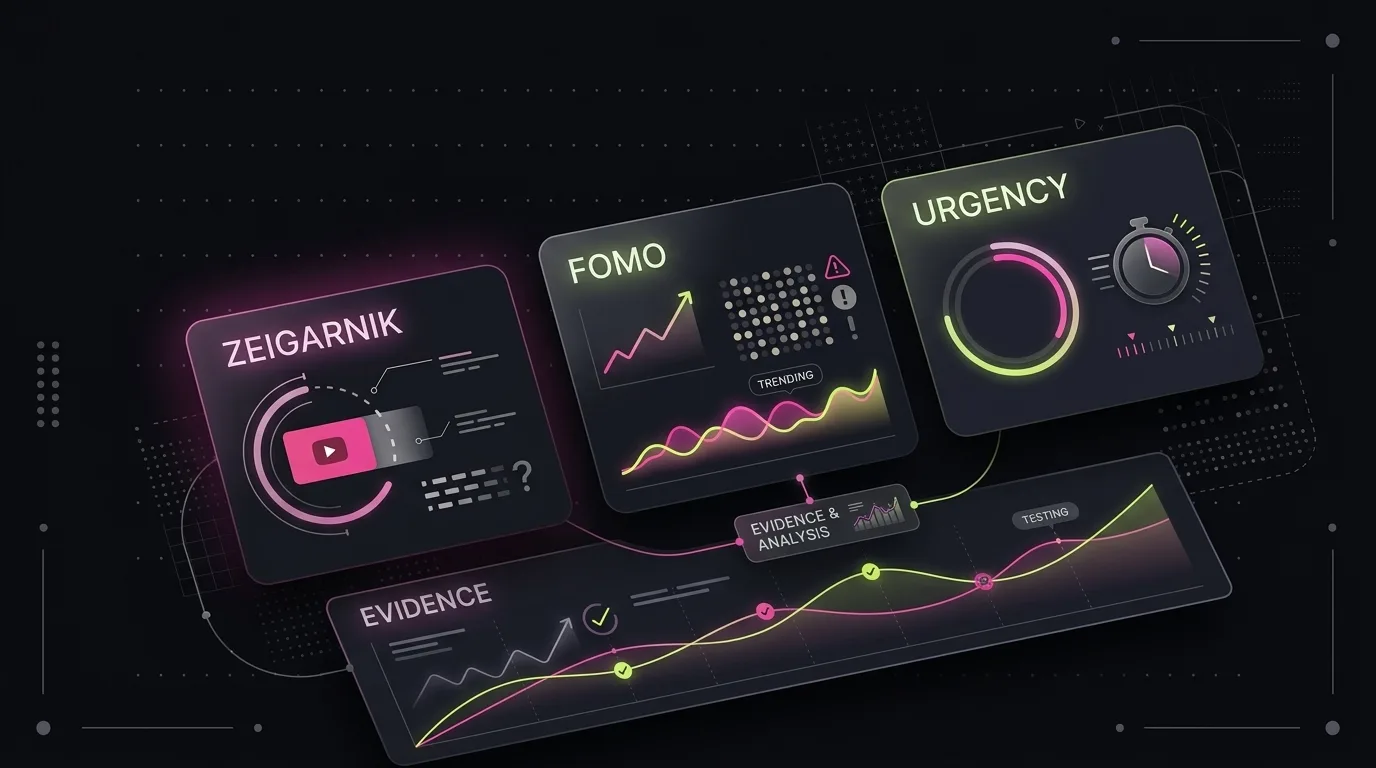
Most of the psychological triggers quoted in thumbnail advice have far less evidence behind them than their names suggest. The Zeigarnik effect, as usually told, does not replicate. We found no study linking fear of missing out to clicks on a headline or a video. Scarcity research is about buying, not clicking. And in our own scores of 642 real thumbnails, four of these "triggers" moved together so closely that they behaved like one measure under four names.
Key takeaways
- A 2025 meta-analysis found no memory advantage for unfinished tasks, which is the claim usually made in the Zeigarnik effect's name. What does hold up is a tendency to go back to an interrupted task.
- Fear of missing out is studied as a trait of social-media users. We found no study of it as a property of a title or a thumbnail that changes clicks.
- Scarcity and urgency messages raise purchase intention moderately, under a real limit. A free video has no real limit, and the transfer is unproven.
- The best evidence on real clicks is about concreteness and tone: clicks peak at a middle level of specificity, and negative words raise them slightly.
- We changed our score accordingly on 4 October 2026: the dimension once called Zeigarnik is now "Withheld Answer", and no analysis is required to recommend a "dark psychology" tactic any more.
Do psychological triggers like Zeigarnik and FOMO increase YouTube clicks?
The honest answer is that the evidence is thin for most of them and contradicts one of them. What does have support on real clicks is narrower and less exciting: a title that names a concrete outcome while holding back how it was reached, and wording whose tone fits the video. The trigger names add a sense of science to advice that mostly reduces to "leave one honest question open".
We looked because our own score rates five of these triggers by name, beside curiosity and emotion, and a score that names a mechanism is implicitly claiming the mechanism is real. So we read what research on real people says about each one, and checked how they behaved in the data we already had.
What the research says, trigger by trigger
We set aside every figure we could not trace to a study, which removed most of what circulates in creator advice. What remained is below, with how strong each piece of evidence is for clicks specifically. For several sources we read the abstract and summaries rather than the full paper, and we say so where it matters.
| Trigger | What the evidence on real people says | Strength for clicks |
|---|---|---|
| Curiosity | On thousands of randomized headline tests, clicks peak at a middle level of concreteness: too vague loses, and too specific loses too. Controlled studies found that clickbait headlines did not raise curiosity or clicks | Good, real clicks |
| Zeigarnik effect | A 2025 meta-analysis found no memory advantage for unfinished tasks, but a general tendency to resume them (the Ovsiankina effect) | Good, and against the usual claim |
| Cliffhanger | No study of its own; it is the narrative form of curiosity | Inferred only |
| FOMO | Studied as a personality trait of social-media users, not as a feature of a headline | None found |
| Urgency and rarity | Scarcity messages raise purchase intention moderately across about 130 studies, for products under a real limit | Transfer to clicks unproven |
| Emotion | On real headline tests, each negative word raised clicks by about 2.3% for an average headline, and each positive word lowered them by about 1% | Good for wording |
The Zeigarnik effect is not what thumbnail advice says it is
The usual story is that people remember unfinished things better, so an open loop in a title lodges in the viewer's mind until they click. Ghibellini and Meier's 2025 meta-analysis, the first across this literature, pooled 59 publications. On memory, the ratio of recall for unfinished against finished tasks came out at 0.99: no advantage. What it did find is that people tend to go back to an interrupted task, which psychologists call the Ovsiankina effect. That is closer to "people like to finish what they started" than to "an unanswered question haunts the viewer". We read its abstract and summaries; the full text was not reachable.
Urgency and scarcity come from shopping, not from feeds
The scarcity research is real, and it is about buying something that will genuinely run out. A video does not run out. A countdown or "last chance" on a free video borrows the language of that research without its conditions, and there is no evidence the effect carries over. A duration in a title, such as "30 days", is something else again: it makes the promise specific, which is the concreteness effect above, not urgency.
Rarity is a claim, not a trigger
Rarity, the last of these factors, is the signal that a video offers something exclusive or hard to get: "secret", "nobody shows you this", "inside", "first look". It comes from the same scarcity research as urgency, and it carries over even less well: that research is about goods that run out, while information shown in a video does not run out when more people watch it. We found no study of exclusivity wording as a property of a title or a thumbnail that changes clicks.
What rarity can do honestly is describe the video. Access no one else had, data no one else has published or a place viewers cannot visit is real exclusivity, and saying so makes the promise more specific. "Secret" on advice found in every other video is the opposite: a promise the video cannot keep, which is what our score counts as clickbait risk. Our score rates rarity but never requires it, and the suggested titles never invent it.
Five names, mostly one measure
The second problem showed up in our own data. In the 642 thumbnails and titles we scored for our published test of the score, the model rated curiosity, cliffhanger, the Zeigarnik dimension and FOMO separately. Across those videos, the four ratings correlated with one another between 0.73 and 0.88. Cliffhanger and curiosity reached 0.88; the Zeigarnik dimension correlated 0.82 with curiosity and 0.81 with cliffhanger.
Ratings that close are not four findings. They are one quality, roughly "how much the packaging leaves open", counted four times. That is not wrong in itself, but presenting it as four independent levers overstates what any one of them adds. Emotion, for its part, barely separated a channel's better-performing videos from its weaker ones in that study, with an effect size of 0.06, which is close to nothing.
What we changed in our score
We kept the twelve dimensions, so stored results stay comparable, and changed what the model is told about them. These changes have been live since 4 October 2026:
- The dimension stored as Zeigarnik is called "Withheld Answer" everywhere in the interface: a title or image that points to an answer, a method or a result and holds it back. It no longer claims anything about the viewer's memory.
- A dramatic transformation no longer earns a minimum FOMO rating, a rule that had no source.
- A duration counts as specificity, not as urgency.
- Negative tone counts in emotion, while hostility and outrage earn nothing.
- An analysis is no longer required to recommend two "dark psychology" tactics. Recommendations put the biggest levers first and name a trigger only when it is true of the video, and the suggested titles never invent urgency, scarcity or a crowd.
The same day, the reference cases we check every change against still passed. Urgency and FOMO ratings dropped on the cases where they had been inflated, and global scores stayed within the spread between two repeats of the same request. Whether the new instructions rank real YouTube videos better or worse has not been measured yet; that needs a new paid run of the full validation set.
How to use open loops without leaning on myths
- State the outcome concretely and hold back the method. "I cut my editing time in half" with the how left for the video sits at the middle level of concreteness that won on real clicks.
- Leave one question open, not three. Curiosity, cliffhanger and the withheld answer are mostly the same lever, and pulling it harder makes the promise vaguer, not stronger.
- Do not add a countdown, "last chance" or "before it's deleted" to a video that is not going anywhere. There is no evidence it raises clicks, and it is a promise the video cannot keep.
- Choose the tone the video actually has. Negative wording can earn clicks, but a frightened or angry title on a calm tutorial sets an expectation the video then disappoints.
- Check whether the packaging still says what the video is. You can score your thumbnail and title and read promise clarity beside the withheld answer: when clarity falls as curiosity rises, the open loop has become a blind spot.
Limits of this review
This is a review of other people's research plus one observation from our own scores, not a new experiment on viewers. Several sources were read in abstract form only. The real-click evidence comes from a news site's headline tests between 2013 and 2015, not from YouTube, and it says nothing about thumbnails, which that archive does not contain. The correlations among our ratings describe how one model scores packaging, which could partly be the model's habit rather than a property of the videos. Absence of evidence for FOMO on clicks is not evidence that it never works; it means no one we could find has shown that it does.
The companion to this article is our test of our own title rules against real clicks, which found that a question mark, often sold as a curiosity trigger, marked the weaker headline.
Sources
- Aubin Le Quéré, M. and Matias, J. N. (2025). When curiosity gaps backfire: effects of headline concreteness on information selection decisions. Scientific Reports, 15, 994. doi:10.1038/s41598-024-81575-9
- Molina, M. D., Sundar, S. S., Rony, M. M. U., Hassan, N., Le, T. and Lee, D. (2021). Does clickbait actually attract more clicks? Three clickbait studies. Proceedings of CHI 2021. par.nsf.gov
- Ghibellini, R. and Meier, B. (2025). Interruption, recall and resumption: a meta-analysis of the Zeigarnik and Ovsiankina effects. Humanities and Social Sciences Communications, 12. doi:10.1057/s41599-025-05000-w
- Przybylski, A. K., Murayama, K., DeHaan, C. R. and Gladwell, V. (2013). Motivational, emotional, and behavioral correlates of fear of missing out. Computers in Human Behavior, 29(4), 1841–1848. doi:10.1016/j.chb.2013.02.014
- Barton, B., Zlatevska, N. and Oppewal, H. (2022). Scarcity tactics in marketing: a meta-analysis of product scarcity effects on consumer purchase intentions. Journal of Retailing, 98(4), 741–758. doi:10.1016/j.jretai.2022.06.003
- Robertson, C. E., Pröllochs, N., Schwarzenegger, K., Pärnamets, P., Van Bavel, J. J. and Feuerriegel, S. (2023). Negativity drives online news consumption. Nature Human Behaviour, 7, 812–822. doi:10.1038/s41562-023-01538-4
Frequently asked questions
Is the Zeigarnik effect real?
The memory version usually quoted is not supported: a 2025 meta-analysis found no recall advantage for unfinished tasks. A related tendency, going back to finish an interrupted task, does hold up. For a YouTube title, that supports leaving an honest question open, not the idea that an unanswered hook stays stuck in the viewer's memory.
Does FOMO increase CTR on YouTube?
We found no study showing it. Fear of missing out has been studied as a trait of social-media users, not as something a title or thumbnail can switch on. It may work in some cases, but claims that FOMO thumbnails raise click-through rates are not backed by evidence we could find.
Do urgency words like "now" or "last chance" work in titles?
Scarcity messages raise purchase intention when something genuinely runs out, which a free video does not. There is no evidence the effect carries over to clicks on a video, and a false deadline sets up a disappointment. A concrete number or duration is a safer way to make a title specific.
Why did ThumbSignal rename the Zeigarnik dimension?
Because the name claimed a memory effect that does not replicate. The dimension still rates the same thing, whether the title or image points to an answer and holds it back, and it keeps its place in the score so earlier results stay comparable. It is now called "Withheld Answer".
What actually makes people click a headline?
The strongest evidence on real clicks points to a middle level of concreteness, where the outcome is clear and the method is held back, and to tone, with negative words raising clicks slightly. In our own data, the clarity of the promise separated a channel's better videos from its weaker ones more than any trigger did.