
Key takeaways
- Arrows and the direction of a face's gaze move a viewer's attention almost automatically: lab studies show it, so the device works as a pointer.
- A pointer is only as good as what it points at. An arrow or circle around nothing teaches viewers that your signals are empty.
- The one public test of shocked faces, by MrBeast in 2023, found his closed-mouth thumbnails won more watch time than open-mouth ones. He published no figures, and both versions were still big expressions.
- A face that promises an emotion the video does not deliver is the misleading-thumbnail pattern YouTube's policies describe.
- No published study measures these devices' effect on YouTube click-through rate. Test your own thumbnails rather than trusting a rule.
Do arrows, red circles and shocked faces still work on YouTube?
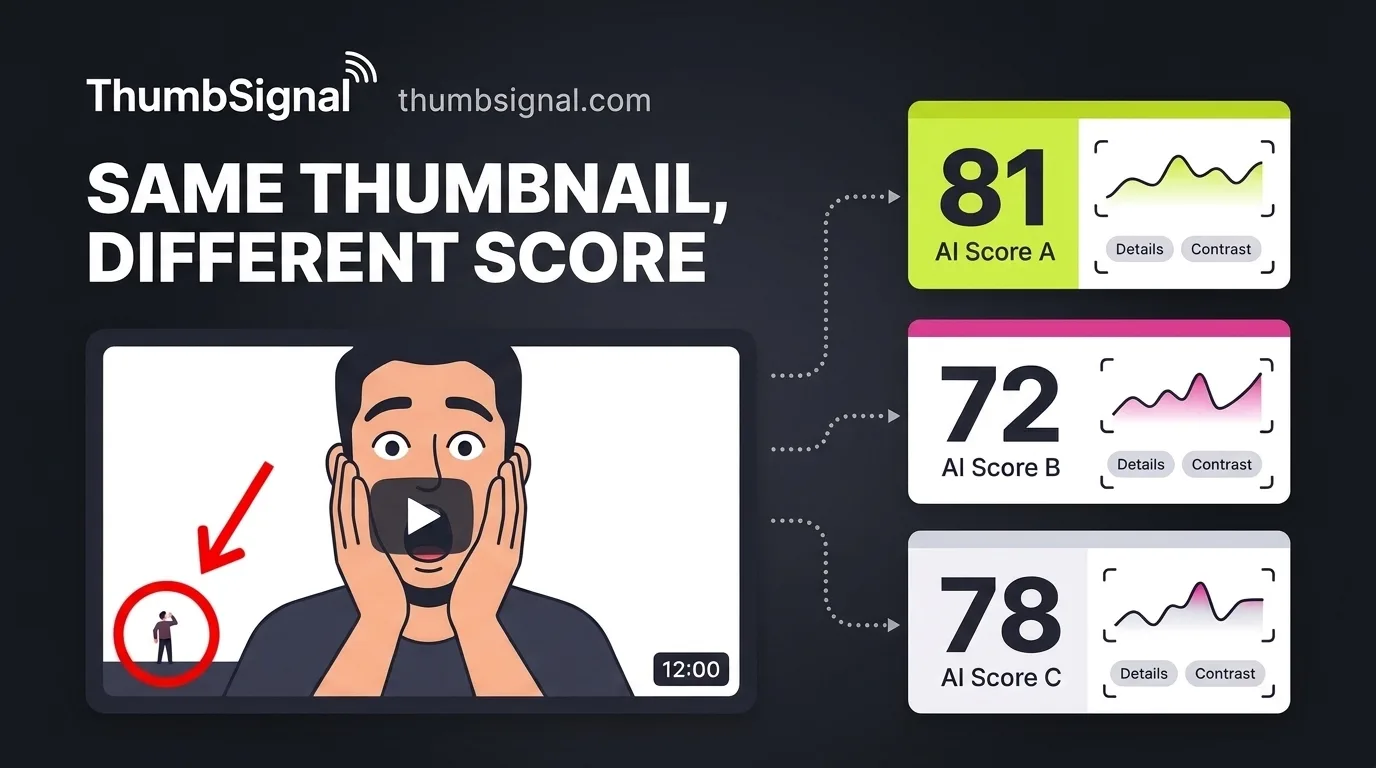
They still work as attention cues: arrows and a face's gaze steer where people look, and attention research shows this happens almost without effort. Whether that earns a click depends on what they point to. Aimed at a real detail the video shows, they help; aimed at nothing, or promising a reaction the video lacks, they read as clickbait.
The rest of this article separates what is measured from what is opinion. The attention effects come from controlled experiments. The effect on YouTube clicks has not been published by anyone, YouTube included, so every claim about click-through rate below is labelled as reasoning or as one creator's own test.
Why arrows and red circles pull the eye
Arrows trigger a near-automatic shift of attention
In four pairs of experiments, Hommel, Pratt, Colzato and Godijn (2001) showed people an arrow or a direction word at the centre of a screen, then a target to one side. The arrow told them nothing useful about where the target would appear, yet people still responded faster when the target landed where the arrow pointed. The authors concluded that the learned meaning of a symbol like an arrow is tightly linked to reflexive shifts of attention.
That is the real basis for arrows in thumbnails: they move the eye even when the viewer does not decide to follow them. The same finding also sets the limit. An arrow sends attention somewhere; it does not make that place interesting. If the viewer follows the arrow and finds a blurry corner or a generic background, the cue has spent the attention you had.
Red circles work as a spotlight, not a promise
A circle draws a boundary around one spot, and red stands out against most video frames, which is why creators reach for it. It is useful when the thing that matters is small: a setting in a software menu, a part on a circuit board, a change between a before and an after shot. It fails when the circled area is too small to read once the thumbnail is shown at feed size, or when it surrounds something the video never explains.
Check the circle at the size viewers will meet it. A thin red line that is obvious on your editing monitor can vanish on a phone. Our article on thumbnail contrast and color shows how to test that.
What shocked faces do, and what the closed-mouth test showed
Where the face looks matters as much as the face
Faces direct attention through their gaze. Friesen and Kingstone (1998) showed people a simple drawing of a face looking left or right, and they detected targets faster on the side the eyes looked toward, even though the gaze did not predict where the target would appear. Sajjacholapunt and Ball (2014) carried this into advertising: in an eye-tracking study, a face looking toward the product and text drew more attention to them and improved memory for the brand and message. A face looking straight at the viewer pulled attention onto itself instead.
For a thumbnail, that suggests a practical choice. If the point of the thumbnail is the face, as with a reaction or a personal story, direct eye contact suits it. If the point is an object, a result or a piece of text, a face turned toward it can do the job an arrow does. Our article on what the evidence says about faces in thumbnails covers the wider research.
Open mouth or closed mouth
The best-known test of the shocked face comes from MrBeast. In September 2023 he posted that his watch time went up after he switched to thumbnails with his mouth closed, and shared the YouTube test results that marked the closed-mouth versions as winners. Treat it as one creator's report: he published no numbers, the test measured watch time rather than clicks, and as Creative Bloq pointed out, the winning versions were still big, toothy grins rather than neutral faces.
So the test does not show that expressive faces stopped working. It suggests that the stock open-mouth shock had become so common that a slightly different expression stood out more, on one of the largest channels on the platform. Whether the same holds for your channel is something only your own test can tell you.
When thumbnail clichés turn into clickbait
The line is the promise. YouTube's spam and deceptive practices policies treat thumbnails and titles that mislead viewers about the content as a violation, and in December 2024 YouTube announced stronger enforcement against egregious clickbait, starting in India, aimed at thumbnails and titles that promise something the video does not contain. An arrow at a "hidden detail" the video never mentions, or a terrified face on a calm tutorial, is the pattern those policies describe.
Even short of a policy problem, a mismatch costs you. A viewer who clicks for a reaction and finds a slideshow leaves early, and YouTube says its recommendations weigh watch time and viewer satisfaction, not clicks alone. Our article on clickbait versus curiosity goes through that trade-off.
Overuse is the quieter cost. This part is reasoning, not a measured result: if every thumbnail on a channel has an arrow, a circle and a gasping face, none of them signals that this video is different, and the channel's thumbnails start to look interchangeable. A device you save for videos that need it keeps its meaning.
When each device helps and when it fails
This table sums up the conditions above. It describes where each device has a reason to be there; it is not a ranking of click-through rates, which no public data provides.
| Device | Helps when | Fails when |
|---|---|---|
| Arrow | It points at one specific detail the video shows and explains | It points at empty space, or several arrows compete |
| Red circle | The key detail is small and still readable at feed size | The circled area cannot be read on a phone, or the video never mentions it |
| Shocked face | The video contains the surprise the face promises | The video is calm or routine, so the face misleads |
| Face looking at the subject | The subject is an object, result or text you want read | The gaze points away from anything that matters |
If a thumbnail already has one clear focal point, it may need none of these. Our guide to building a thumbnail around one focal point shows how composition and contrast can do the pointing.
How to check a thumbnail before you add an arrow, circle or face
Run these steps on the finished thumbnail, at the size viewers will see it:
- Name the one thing the viewer should notice. If you cannot, fix that before adding any device.
- If you add an arrow, make sure it points at that thing, and only one arrow does.
- If you add a circle, shrink the thumbnail to phone size and check that what is inside the circle can still be read.
- If you use a face, match its expression to what happens in the video, and decide whether it should look at the viewer or at the subject.
- Watch your own video's first minute and ask whether a viewer who clicked for that arrow, circle or face gets it. If not, change the thumbnail.
- If you have two versions, test them with YouTube's thumbnail test in YouTube Studio rather than guessing.
Before you publish, you can also run the thumbnail and title through ThumbSignal's free YouTube thumbnail analyzer. It does not look for arrows or circles as such. It scores 12 factors, among them thumbnail readability, emotion, coherence between the thumbnail and the title, promise clarity and clickbait risk, which are the things these devices are meant to serve. The user guide explains how each factor is scored.
Sources
- Hommel, B., Pratt, J., Colzato, L. and Godijn, R. (2001). Symbolic control of visual attention. Psychological Science, 12(5), 360-365. doi.org
- Friesen, C. K. and Kingstone, A. (1998). The eyes have it! Reflexive orienting is triggered by nonpredictive gaze. Psychonomic Bulletin and Review, 5(3), 490-495. doi.org
- Sajjacholapunt, P. and Ball, L. J. (2014). The influence of banner advertisements on attention and memory: human faces with averted gaze can enhance advertising effectiveness. Frontiers in Psychology, 5, 166. doi.org
- Creative Bloq (2023). Are 'shocked face' YouTube thumbnails finally over? creativebloq.com
- YouTube Help. Spam, deceptive practices and scams policies. support.google.com
- YouTube (2024, 18 December). Strengthening enforcement against egregious clickbait on YouTube. Google India Blog. blog.google
- Goodrow, C. (2021). On YouTube's recommendation system. YouTube Official Blog. blog.youtube
Frequently Asked Questions
Do arrows in thumbnails still increase CTR?
No public study measures it on YouTube. What is measured is that arrows shift attention almost automatically, so an arrow does make viewers look where it points. Whether that raises your click-through rate depends on what is there. Test an arrow version against a version without one rather than assuming.
Is a red circle considered clickbait?
Not by itself. It becomes clickbait when it highlights something the video does not show or explain, which is the kind of misleading thumbnail YouTube's policies describe. A circle around a real, small detail that the video covers is a fair way to point at it.
Can I use shocked faces on educational videos?
Yes, if the video contains the surprise the face promises, such as a result nobody expected. On a calm tutorial, a shocked face misleads viewers. A face looking toward the subject of the lesson can direct attention without promising a reaction.
Did MrBeast stop using open-mouth thumbnails?
In September 2023 he said his closed-mouth thumbnails won more watch time in his own YouTube tests. He did not publish figures, and the winning versions still showed big smiles, so the test compared two expressive faces, not a shocked face with a neutral one.
Should I avoid these elements entirely?
No. They are pointers, and pointers are useful when there is something worth pointing at. Use them when the video delivers what they promise, keep one device per thumbnail, and save them for videos that need them so they keep their meaning.