
Key takeaways
- Urgency is a real time limit: a live stream that ends, an event that closes, a deadline that exists. A deadline you invented is not urgency, it is a false claim.
- Rarity is real scarcity of access: footage, a guest or a first look that few people can offer. “They don’t want you to see this” is not rarity.
- YouTube’s own policies treat a title or thumbnail that promises something the video does not contain as misleading, and since December 2024 it has been removing egregious cases, starting in India.
- In ThumbSignal’s test on 321 pairs of real videos, urgency and rarity separated winners from losers only weakly, and less than promise clarity did.
- The test is simple: could a viewer check the claim, and is it still true when they watch?
What urgency and rarity mean, and how they differ from FOMO
Urgency: a real clock
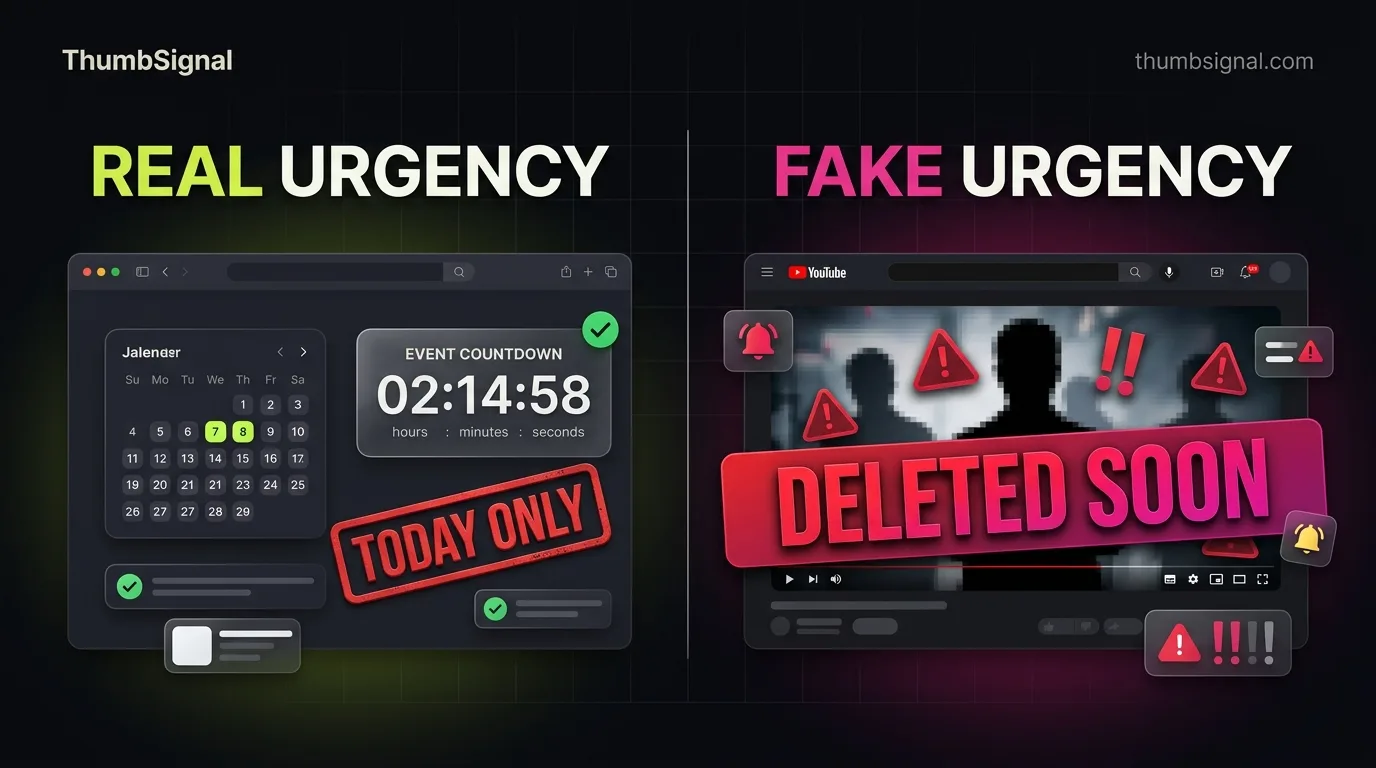
Urgency in a title or thumbnail tells the viewer that something has a time limit. It is honest when the limit exists outside the video: a live stream that ends at 8 PM, an in-game event that closes on Sunday, an exhibition in its last week, a tax deadline. The viewer can check it, and the claim stays true for as long as the video is likely to be watched.
The trap is that a video lives for years while most deadlines do not. “Ends Sunday” in the title of a video that is still recommended three months later becomes false on Monday. Honest urgency is either tied to a date the viewer can see, or it is removed from the title once the date has passed.
Rarity: real scarcity of access
Rarity tells the viewer that what they are about to see is hard to find elsewhere: archive footage, a guest who rarely gives interviews, a first hands-on with a product before release, a place few people can visit. Like urgency, it is honest only when it is true and checkable. “The first review of…” is a claim about the world; if fifty reviews went up the same morning, it is false.
FOMO is the feeling, not the fact
FOMO, the fear of missing out, is the viewer’s response, not a property of the video. Urgency and rarity can trigger it; so can a title that hints at what everyone else already knows. That is why the three are scored separately in ThumbSignal’s analysis, and why the evidence on FOMO and urgency is weaker than most advice suggests. A title can create FOMO honestly, but only urgency and rarity can be checked as facts.
How to use urgency and rarity honestly in titles and thumbnails
Tie urgency to a date the viewer can see
The most durable form of urgency names the event, not the pressure. “Last Week of the Van Gogh Exhibition in Paris” is still accurate after the exhibition closes, because the viewer can see that it was about the last week. “Go See This Before It’s Too Late” is not. For a live stream, put the time in the title while it is live, then rename the replay.
Make rarity specific
Vague rarity reads as hype; specific rarity reads as information. “Footage From Inside the Factory Before It Closed” tells the viewer what is rare and why. “Footage Nobody Has Seen” claims something the viewer has no way to check, and most viewers have learned to discount it.
Let the thumbnail show the scarce thing
A thumbnail cannot carry a long sentence, so it should show the evidence instead: the guest’s face, the closed building, the date on the poster. A red “LIMITED” badge or a countdown graphic adds pressure without adding information. If the claim is true, an image of the thing itself is usually more convincing than a badge saying it is rare.
Honest and fake urgency side by side
The same subject can be packaged honestly or not. The difference is rarely the topic; it is whether the time limit or the scarcity is real, specific and still true when the viewer watches.
| Situation | Honest version | Fake version | Why the fake one fails |
|---|---|---|---|
| Live stream | “Live Q&A Until 8 PM (CET)”, renamed after the stream | “Last Chance to Ask Me Anything”, left on the replay | The replay keeps promising a chance that ended. |
| Seasonal event | “Halloween Event Guide: Every Reward Before Nov 3” | “Do This NOW Before It’s Gone Forever” | No date, no event: the viewer cannot check it. |
| Exclusive access | “Inside the Studio Before It Closed: Our Tour” | “They Don’t Want You to See This” | Implies censorship that does not exist. |
| Early review | “Two Weeks With the Prototype: What Works” | “The FIRST Review Anywhere” on launch day | False as soon as other reviews are published. |
| Video lifetime | No time claim on an evergreen tutorial | “Watch Before This Gets Deleted” | The video is not deleted, so the claim is simply false. |
Why fake urgency and rarity backfire
What YouTube’s policies say
YouTube’s spam and deceptive practices policy lists misleading metadata and thumbnails: titles, thumbnails or descriptions that make viewers believe they will see something the video does not contain. In December 2024 YouTube announced stronger enforcement against what it calls egregious clickbait, starting with a gradual rollout in India. Its examples are a title announcing that “the president resigned!” on a video that never covers a resignation, and a “top political news” thumbnail on a video with no news. A fake deadline is the same kind of promise: “this will be deleted tomorrow” is a claim about the video that the video does not keep.
What recommendations reward
YouTube has explained that its recommendations do not rely on clicks alone: they also weigh watch time and what viewers say in satisfaction surveys. A viewer who clicked because of a deadline that turns out to be false is unlikely to stay or to rate the video well. This does not mean every exaggeration is detected and punished; it means a click earned by a false claim is the kind of click the system is built to discount.
What it costs with your audience
The effect that compounds is trust. A viewer who has been told “last chance” twice, and found both untrue, reads the third one as noise, even when it is real. Honest urgency only works if your audience believes your deadlines, and that belief is easier to lose than to rebuild.
What the data says about urgency and rarity
Weak separators in a test on real videos
ThumbSignal scores urgency, rarity and clickbait risk as three of its twelve sub-scores. In our pre-registered test on 321 pairs of real videos, each pair held two videos from the same channel, one that clearly beat the channel’s own baseline and one that clearly fell short. Urgency differed between winners and losers by a standardised effect of 0.24, rarity by 0.16 and clickbait risk by 0.13. Promise clarity, at 0.31, separated them most.
What that does and does not show
All of these effects are small, and the test measured association, not cause: it does not show that adding urgency to a title makes a video win. What it does suggest is that time pressure and scarcity are not the levers that most often distinguished a channel’s better videos from its weaker ones. Whether the viewer understood what they would get mattered more. Research on scarcity is mostly about buying, not clicking, and several of these trigger scores move together so closely that they behave almost like one measure, as the review of the evidence on click triggers sets out.
How the score treats a false promise
In ThumbSignal’s score, clickbait risk is not averaged in with the other factors. It is a penalty applied to the combined result, so a title whose urgency overpromises loses points across the whole score, not just on one line. The guide to how the score works explains how the penalty grows with the size of the overpromise.
How to test whether your urgency or rarity is honest
Three questions before you publish
Ask whether a viewer could check the claim, whether it will still be true in a month, and whether you could explain it in one sentence if a viewer asked. If any answer is no, rewrite the claim or drop it. A title that names the subject clearly, such as “How I Got Into the Closed Beta: Full Walkthrough”, does not need urgency to earn a click.
A five-step check
- Name the real constraint: the date, the event or the access that makes this time-limited or rare. If you cannot name one, there is none.
- Put the specific fact in the title: a date, a time, a place or a person, not “last chance” or “before it’s gone”.
- Show the scarce thing in the thumbnail instead of a badge that says it is scarce.
- Check the claim against the video’s lifetime: will it still be true for someone who finds the video in three months? If not, plan to rename it.
- Score the title and thumbnail together, and watch the clickbait-risk penalty: if it rises when you add urgency, the claim is outrunning the video.
When to leave urgency out
Most videos have no real deadline, and that is fine. An evergreen tutorial, a review or an explainer earns its clicks through a clear promise. Adding a time limit to them does not make them more valuable; it adds a claim that will become false.
Check your own title before you publish
If you want to see how your title and thumbnail read before they go live, you can score them with ThumbSignal’s free checker. It reports urgency, rarity and clickbait risk among its twelve sub-scores, and lists the changes most likely to raise the overall score. No tool can promise a higher click-through rate, but checking whether your promise is clear and true is the part you control.
For worked cases, the before-and-after examples show a title made deliberately less tense and what happened to its score, including the clickbait-risk penalty.
Sources
- YouTube Help. Spam, deceptive practices and scams policies. support.google.com
- YouTube (2024, 18 December). Strengthening enforcement against egregious clickbait on YouTube. Google India Blog. blog.google
- Goodrow, C. (2021). On YouTube’s recommendation system. YouTube Official Blog. blog.youtube
- ThumbSignal (2026). Score discrimination study: 321 pairs of real videos, pre-registered. thumbsignal.com/en/study
Frequently Asked Questions
Is it okay to use “last chance” in a YouTube title?
Only if there is a real, nameable deadline, and only while it holds. Better still, name the deadline itself (“Until Nov 3”) so the title stays accurate after it passes, or rename the video once it has.
Can I say “exclusive” if I’m the only one covering a topic?
If you are genuinely the only source, yes, but check first: coverage appears fast. “First look” or “inside” plus the specific thing you have access to is usually clearer and harder to disprove.
Does fake urgency ever work long-term?
It can win a click, but YouTube’s policies treat promises the video does not keep as misleading, its recommendations weigh watch time and satisfaction, and viewers learn to ignore deadlines that never arrive. None of that rewards a false claim over time.
How do I know if my title is clickbait?
Ask whether the video delivers what the title and thumbnail promise, early and in full. If the honest answer is “partly” or “later”, the packaging is promising more than the video gives.
Should I avoid urgency and rarity altogether?
No. Real deadlines, real access and real events are useful information for a viewer. The rule is to state them as facts the viewer can check, not as pressure.