
Key takeaways
- YouTube CTR measures how often viewers click your thumbnail after seeing it — higher CTR signals relevance and can improve visibility.
- Clickbait sacrifices viewer trust for short-term clicks; ethical CTR growth relies on clarity, contrast, and coherence in thumbnails and titles.
- Strong CTR without clickbait aligns with viewer satisfaction, which supports retention — a key signal YouTube uses to recommend your content.
- Use a pre-publish checklist to audit thumbnails and titles for honesty, visual impact, and relevance before going live.
- No CTR technique guarantees results — outcomes depend on audience, niche, and content quality, not just optimization.
How to increase YouTube CTR without clickbait
YouTube CTR — click-through rate — measures how often viewers click your video after seeing it in recommendations or search. To increase it without clickbait, focus on thumbnails and titles that are visually clear, emotionally relevant, and accurately represent the content. This builds trust and brings viewers back, and YouTube says its recommendations weigh viewer satisfaction, not clicks alone.
Clickbait promises more than the video delivers — think exaggerated faces, misleading text, or sensational hooks that don’t match the content. While it may spike initial clicks, it damages retention and viewer trust, which can hurt long-term channel growth. Ethical CTR optimization uses curiosity, not deception, to draw viewers in.
Curiosity is a legitimate tool: it invites viewers to learn more by hinting at value without lying. A thumbnail showing a surprising result, a clear problem-solution contrast, or a recognizable face with a genuine expression can spark interest without misrepresentation. The key is to deliver on the promise — if your thumbnail shows a “shocking result,” the video must actually reveal it.
What is CTR, curiosity, and clickbait — and why they matter
CTR is the percentage of impressions that turn into clicks — if your video gets 1,000 impressions and 50 clicks, your CTR is 5%. YouTube describes clicks as one of the signals its recommendations use, alongside watch time, survey responses, shares, likes and dislikes. Higher CTR often means your thumbnail and title resonate with the audience — but only if it leads to satisfying content.
Curiosity is the psychological trigger that makes viewers want to know more. It’s not about withholding information — it’s about framing the video’s value in a way that invites discovery. For example, “I tested 5 productivity apps — here’s the only one that worked” creates curiosity by implying a clear outcome, not by hiding it.
Clickbait, by contrast, exploits curiosity by creating false expectations. It might use misleading text, exaggerated expressions, or irrelevant imagery to trick viewers into clicking. YouTube’s policies prohibit malicious clickbait, and its recommendations weigh viewer satisfaction, measured partly through surveys; a viewer who feels misled has little reason to stay or to rate the video well.
YouTube CTR optimization: clarity, contrast, and coherence
Optimizing CTR ethically means designing thumbnails and titles that are instantly understandable, visually striking, and aligned with the video’s actual content. Clarity ensures viewers know what they’re getting; contrast makes your thumbnail stand out in a feed; coherence means the thumbnail, title, and video all tell the same story.
Clarity starts with legible text, recognizable faces, and simple compositions. Avoid clutter — if a viewer can’t grasp the video’s topic at a glance, they’ll scroll past. Use bold, high-contrast fonts and keep text to a few words. Show the main subject clearly: if it’s a tutorial, show the tool or result; if it’s a reaction, show the genuine expression.
Contrast isn’t just color — it’s also emotional and conceptual. A thumbnail that shows a “before” and “after” creates visual contrast that draws the eye. Use complementary colors (like blue and orange) or high saturation to make your thumbnail stand out in both the light and dark YouTube interface. But avoid garish combinations that look like clickbait — subtlety often works better.
Coherence means your thumbnail, title, and video all deliver the same message. If your title says “How to Fix a Leaky Faucet,” your thumbnail should show a faucet, not a person screaming. Misalignment confuses viewers and hurts retention. Test your thumbnail and title together: if you wouldn’t click it yourself, it’s not coherent.
How CTR, satisfaction, and retention are connected
YouTube’s recommendation system doesn’t just reward high CTR — it rewards videos that keep viewers watching. YouTube says it aims for “valued watchtime” and measures viewer satisfaction, so clicks that end in early exits do little on their own. That’s why ethical CTR optimization focuses on attracting the right viewers, not just any viewers.
Satisfaction is the bridge between CTR and retention. A viewer who clicks because your thumbnail clearly promises value is more likely to watch the full video — especially if the content delivers on that promise. For example, a thumbnail showing a “$100 vs $1000 Camera Test” with a clear side-by-side image will attract viewers interested in gear comparisons, who are more likely to watch the entire test.
Watch time is one of the signals YouTube says its recommendations use. Imagine viewers watch 70% of your video: that is a strong sign they found what the packaging promised. This creates a virtuous cycle: clear, honest thumbnails attract engaged viewers, who watch longer, which can lead to more impressions and higher CTR — without clickbait. YouTube has not published a retention threshold for recommendations, so read the 70% as an illustration, not a rule.
Pre-publish checklist for ethical CTR growth
Before publishing, audit your thumbnail and title to ensure they’re optimized for clarity, contrast, and coherence — not just clicks. This checklist helps you avoid accidental clickbait and align with viewer expectations.
- Ask: “Does this thumbnail accurately represent the video’s content?” If not, revise it.
- Check text legibility: Is the font large, bold, and readable on mobile? If not, simplify or enlarge it.
- Test contrast: Does the thumbnail stand out against both the light and dark YouTube interface? If not, adjust colors or saturation.
- Verify coherence: Does the title match the thumbnail? If they tell different stories, rewrite one to align.
- Assess curiosity: Does the thumbnail invite discovery without deception? If it feels misleading, reframe it honestly.
- Preview on mobile: Does it work at small size? If not, simplify the composition.
Use this checklist every time you publish — it’s a simple habit that prevents costly mistakes and builds viewer trust over time. For a deeper dive into how our own score reads a thumbnail and title, check out our guide to the 0-100 thumbnail score.
Clickbait risk: why misleading thumbnails hurt your channel
Clickbait might give you a short-term CTR boost, but it carries long-term risks. Viewers who feel tricked are less likely to subscribe, comment, or watch future videos — and YouTube says its recommendations weigh viewer satisfaction, measured partly through survey ratings, not clicks alone.
YouTube’s policies prohibit malicious clickbait: titles, thumbnails or descriptions that mislead viewers about what the video contains. YouTube may remove such content and give the channel a warning or a strike. Below that line, YouTube publishes no separate penalty, but its recommendations weigh viewer satisfaction, so packaging that disappoints works against you. Channels that rely on clickbait can see spikes followed by declines, because they are not building a loyal audience.
Promise clarity is the antidote. If your thumbnail shows a result, the video must deliver it. If your title says “I tried this for 30 days,” the video must show the full journey. This honesty builds credibility, which leads to higher retention and more sustainable growth. For a worked example of this approach, see our before-and-after examples.
Improve YouTube CTR: practical steps for sustainable growth
Improving CTR without clickbait requires consistent, intentional design — not gimmicks. Start by analyzing your top-performing thumbnails and titles to identify patterns: what colors, compositions, or phrasing work best for your audience? Then apply those insights to new videos.
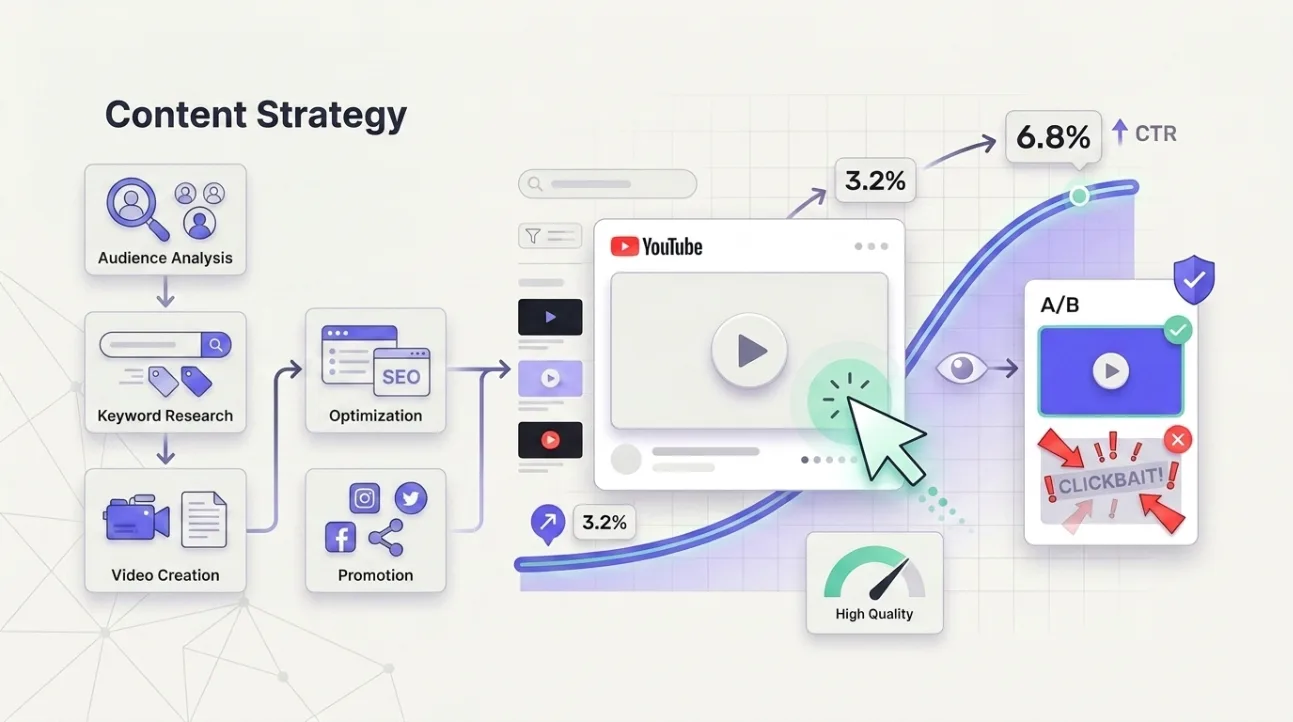
Use A/B testing to compare different thumbnails and titles. YouTube Studio’s Test & compare shows up to three versions to viewers at the same time and picks the winner on watch time, not CTR. Read CTR and retention together — a thumbnail with 8% CTR but 40% retention can be worse than one with 6% CTR and 70% retention (these are invented figures to show the trade-off, not benchmarks).
Study your competitors — not to copy them, but to understand what works in your niche. If most tech reviewers use clean, high-contrast thumbnails with bold text, that’s a signal your audience expects that style. Adapt it to your brand, but don’t deviate so far that you lose clarity.
For a quick, free analysis of your next thumbnail and title, try our YouTube thumbnail and title optimizer — it scores your thumbnail and title on twelve factors, including thumbnail readability, promise clarity, coherence and clickbait risk, before you publish.
Correction, 17 October 2026. An earlier version said YouTube “will stop promoting” videos with low retention and “increasingly penalizes” clickbait, called our score YouTube’s, and described YouTube’s test as comparing two versions. These have been corrected against YouTube’s own statements.
Sources
- Goodrow, C. (2021). On YouTube’s recommendation system. YouTube Official Blog. blog.youtube
- YouTube Help. Spam, deceptive practices and scams policies. support.google.com/youtube/answer/2801973
- YouTube Help. Impressions and click-through-rate FAQs. support.google.com/youtube/answer/7628154
- YouTube Help. A/B test titles and thumbnails (Test & compare). support.google.com/youtube/answer/13861714
Frequently Asked Questions
What is a good YouTube CTR?
It varies by niche, audience and traffic source. YouTube publishes no target, but says half of all channels and videos have an impressions CTR between 2% and 10%. New channels often start lower, so the comparison that matters is your own channel’s recent average for similar videos and traffic sources.
Can I increase CTR without changing my thumbnail?
Yes — your title plays a huge role. A clear, benefit-driven title paired with a strong thumbnail can boost CTR. But thumbnails are the first visual cue, so optimizing both together yields the best results.
Does YouTube penalize low CTR?
Not directly — YouTube doesn’t punish low CTR. But clicks are one of the signals its recommendations use, so packaging that viewers consistently pass over gives the system less reason to show the video. Improving CTR can help you get more impressions.
How long does it take to see CTR improvements?
Results vary — some creators see changes within days, others take weeks. Consistency matters: test one change at a time, track results, and refine based on data. Don’t expect overnight miracles.
Is it possible to have high CTR and low retention?
Yes — that’s often a sign of clickbait. High CTR with low retention tells YouTube your content isn’t satisfying viewers, which can limit future impressions. Aim for both high CTR and high retention.