
Key takeaways
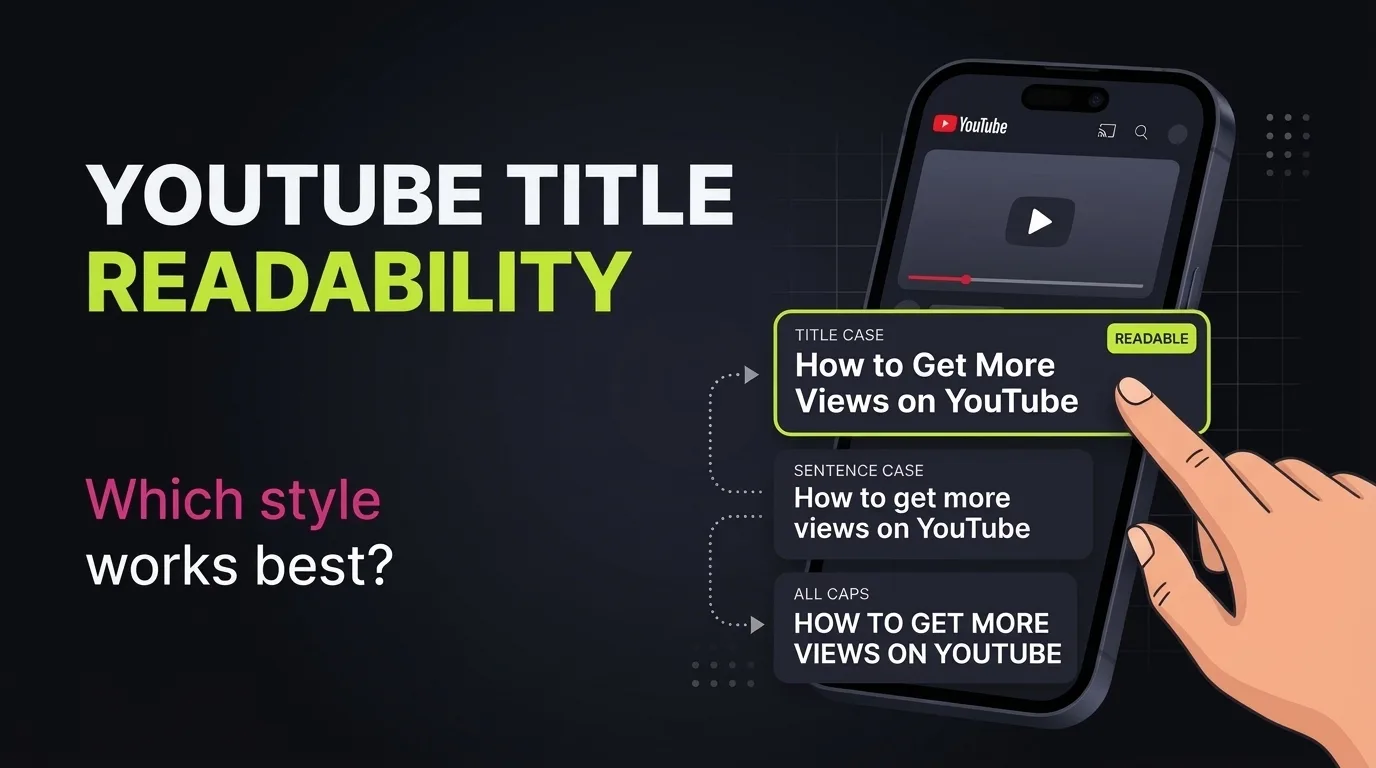
- YouTube titles in title case capitalize the first letter of each major word, while sentence case only capitalizes the first word and proper nouns.
- YouTube’s own advice is to limit ALL CAPS and keep them for emphasis, and reading studies find all-capital text slower to read than lowercase.
- One or two words in capitals is the use YouTube’s tips describe: occasional emphasis, not a whole title.
- A consistent capitalization style across your channel can make your videos easier to recognize. That is an editorial judgment, not a measured effect.
- Our analyzer flags one capitalization pattern only: it lowers the rule-based half of the title score for an all-caps title of three words or more. It does not judge title case against sentence case.
What is YouTube title capitalization and why does it matter?
YouTube title capitalization refers to how you format the capital letters in your video titles — whether you use title case, sentence case, or selective emphasis. Its main effect is on how viewers perceive your title, and YouTube’s own advice is to limit ALL CAPS. A well-formatted title is easier to read and signals care and clarity.
Capitalization is not about SEO keywords — those work the same regardless of case — but about tone, readability, and consistency. Viewers scrolling quickly need to grasp your title at a glance, and awkward capitalization can make a good video look careless.
What’s the difference between title case, sentence case, and selective emphasis?
Title case capitalizes the first letter of each major word — nouns, pronouns, verbs, adjectives, adverbs — while leaving articles, conjunctions, and short prepositions lowercase unless they start or end the title. Style guides disagree on the details: Chicago style lowercases every preposition, while AP style capitalizes prepositions of four letters or more. For example: “How to Master YouTube Title Capitalization in 5 Steps.” Sentence case only capitalizes the first word and proper nouns: “How to master YouTube title capitalization in 5 steps.” Selective emphasis uses a single capitalized word for impact: “How to master YouTube TITLE capitalization in 5 steps.”
Each style serves a different purpose. Title case feels formal and structured, sentence case reads more naturally, and selective emphasis draws attention to a specific concept without overwhelming the viewer. The choice depends on your channel’s tone and the context of the video.
When to use title case
Title case works best for educational, tutorial, or structured content where clarity and hierarchy matter. It visually separates key concepts and makes titles feel authoritative. For example, “Beginner’s Guide to YouTube Title Capitalization” signals a comprehensive, step-by-step resource. Avoid overusing it for casual or conversational videos — it can feel stiff or outdated.
When to use sentence case
Sentence case reads like natural speech and is ideal for vlogs, reviews, or personal content. It feels approachable and reduces visual noise. For example, “I tried every YouTube title format — here’s what worked” invites viewers in without demanding attention. It also stays close to ordinary running text, the format the reading studies below measured as fastest.
When to use selective emphasis
Selective emphasis adds punch without the aggression of all caps. Capitalizing one word — usually the core concept or emotional hook — draws the eye without sacrificing readability. For example, “Why your YouTube TITLE is costing you views” highlights the problem without shouting. This technique works well for channels that want to stand out subtly, especially in crowded niches.
Why all caps titles hurt readability
Reading research finds a lowercase advantage. In an early study, Tinker and Paterson (1928) measured a 13.4% reading-speed advantage for lowercase text, although their uppercase text also took up 35% more space. A 2017 eye-tracking study of Spanish sentences, with 20 native speakers, measured a smaller gap of about 5%: 2,147 ms per uppercase sentence against 2,052 ms per lowercase sentence (Perea, Rosa and Marcet). Both measured full sentences in a laboratory, not YouTube titles. For single words seen at a glance, a team led by Ben Sawyer found uppercase faster (summarized by Nielsen Norman Group), so the advantage does not hold everywhere. We found no controlled test of capitalization on YouTube click-through rate.
Even if your intent isn’t clickbait, all caps can read as shouting, and YouTube says so itself. In 2018 Todd Beaupré, then its group product manager for discovery, said viewers had likened all-caps titles to being “yelled at”, and that YouTube tries “not to recommend off-putting videos to people who aren’t into things like all caps”. That remark is eight years old and carries no figures, so treat it as a direction, not a penalty you can measure. YouTube’s spam policy, for its part, targets titles that mislead about the video, not capitalization.
How one capitalized word can add emphasis without clickbait tone
Capitalizing a single word in an otherwise lowercase or title-case title can highlight the most important concept without turning the whole title into a shout. This is the use YouTube’s own title tips describe: “Limit ALL CAPS and emoji. Use them carefully, to emphasize emotion or special elements in the video”, with the example “Our KIDS Built A ROBOT!”. In the same way, “How to write YouTube titles that actually WORK” puts the weight on the outcome, “WORK”, while the rest of the title stays easy to read.
The key is restraint. Overuse dilutes the effect. Reserve selective capitalization for moments where you want to underscore a specific benefit, emotion, or outcome — not for every title. It’s a tool for emphasis, not a default style.
Why consistency in capitalization helps
Consistency in title capitalization helps viewers recognize your content at a glance. If your channel uses title case for tutorials, sentence case for vlogs, and selective emphasis for announcements, viewers learn to associate each style with a specific type of video. This predictability may make your videos easier to recognize, though we know of no study that measures it.
Switching styles randomly can make your channel feel disorganized. Even if you don’t have a strict rule, pick one primary style per type of video and stick to it. For example, a tech channel might use title case for reviews and sentence case for quick tips, but not mix them within the same category.
How to test your YouTube title capitalization before publishing
Before hitting publish, look at your title where viewers will meet it. Our thumbnail preview shows your thumbnail and title in a search result, a grid, a suggested list and on a phone, which is the quickest way to see whether a capitalization choice stays readable at small size.
Our free YouTube title and thumbnail analyzer scores your thumbnail and title out of 100 and suggests up to five alternative titles. On capitalization it checks one thing: an all-caps title of three words or more loses points on the rule-based half of the title score. It does not rank title case against sentence case, so choose between those on tone and consistency.
YouTube title capitalization: a quick comparison table
| Style | Example | Best For | Readability (editorial judgment, not measured) |
|---|---|---|---|
| Title Case | How to Master YouTube Title Capitalization | Tutorials, educational content | Good — structured and clear |
| Sentence Case | How to master YouTube title capitalization | Vlogs, reviews, personal content | Good — natural lowercase rhythm |
| Selective Emphasis | How to master YouTube TITLE capitalization | Highlighting key concepts or outcomes | Good if used once per title |
| All Caps | HOW TO MASTER YOUTUBE TITLE CAPITALIZATION | Avoid — feels aggressive or clickbaity | Weaker — all-capital text reads more slowly |
Step-by-step: how to choose the right capitalization for your next YouTube title
- Identify the video’s purpose — is it educational, conversational, or promotional?
- Pick a capitalization style that matches your channel’s tone — title case for structure, sentence case for approachability.
- Use selective emphasis sparingly to highlight one key word — usually the benefit or outcome.
- Preview your title at phone size to check readability — if it feels overwhelming, simplify.
- Compare your title to past successful videos on your channel — maintain consistency.
- Run the final title through the analyzer: an all-caps title of three words or more costs points on its rule-based score.
Corrected 1 November 2026: claims about mobile readability, bounce rate and trust were removed or sourced, YouTube’s own advice on ALL CAPS was added, and the description of what our tools do was brought in line with the product.
Sources
- YouTube Help. Thumbnail & title tips. support.google.com
- YouTube Help. Spam, deceptive practices and scams policies. support.google.com
- Weiss, G. (2018, 30 August). YouTube exec says using all caps titles causes videos to perform worse. Tubefilter. tubefilter.com
- Perea, M., Rosa, E. and Marcet, A. (2017). Where is the locus of the lowercase advantage during sentence reading? Acta Psychologica, 177, 30-35. uv.es
- Tinker, M. A. and Paterson, D. G. (1928). Influence of type form on speed of reading. Journal of Applied Psychology, 12, 359-368. doi.org
- Laubheimer, P. (2017). Typography for Glanceable Reading: Bigger Is Better. Nielsen Norman Group. nngroup.com
Frequently Asked Questions
Does YouTube’s algorithm care about title capitalization?
Possibly, for all-caps titles. YouTube’s discovery team said in 2018 that it tries not to recommend them to viewers who find them off-putting, but we found no published figures. The ordinary choice between title case and sentence case has no documented effect. Focus on clarity, tone, and consistency instead of trying to “game” the algorithm.
Is all caps ever acceptable for YouTube titles?
Only in rare cases where the tone matches — for example, a gaming channel using all caps for hype moments. Even then, it should be used sparingly. All-capital text reads more slowly, and many viewers read it as shouting.
Can I mix title case and sentence case on the same channel?
Yes, but only if you assign each style to a specific content type — for example, title case for tutorials and sentence case for vlogs. Mixing them randomly can make your channel feel inconsistent.
How do I know if my title is too hard to read on mobile?
Open the title in our thumbnail preview or on your own phone. If the text feels cramped or requires squinting, simplify it. Shorter titles are easier to read at small size, whatever the capitalization.
Should I capitalize every word in my YouTube title?
Capitalizing the first letter of every major word is title case, and it is a fine choice for tutorials. What to avoid is capitalizing every letter: all caps reads more slowly and often feels aggressive. Use title case for structure, sentence case for natural flow, or one capitalized word for emphasis.