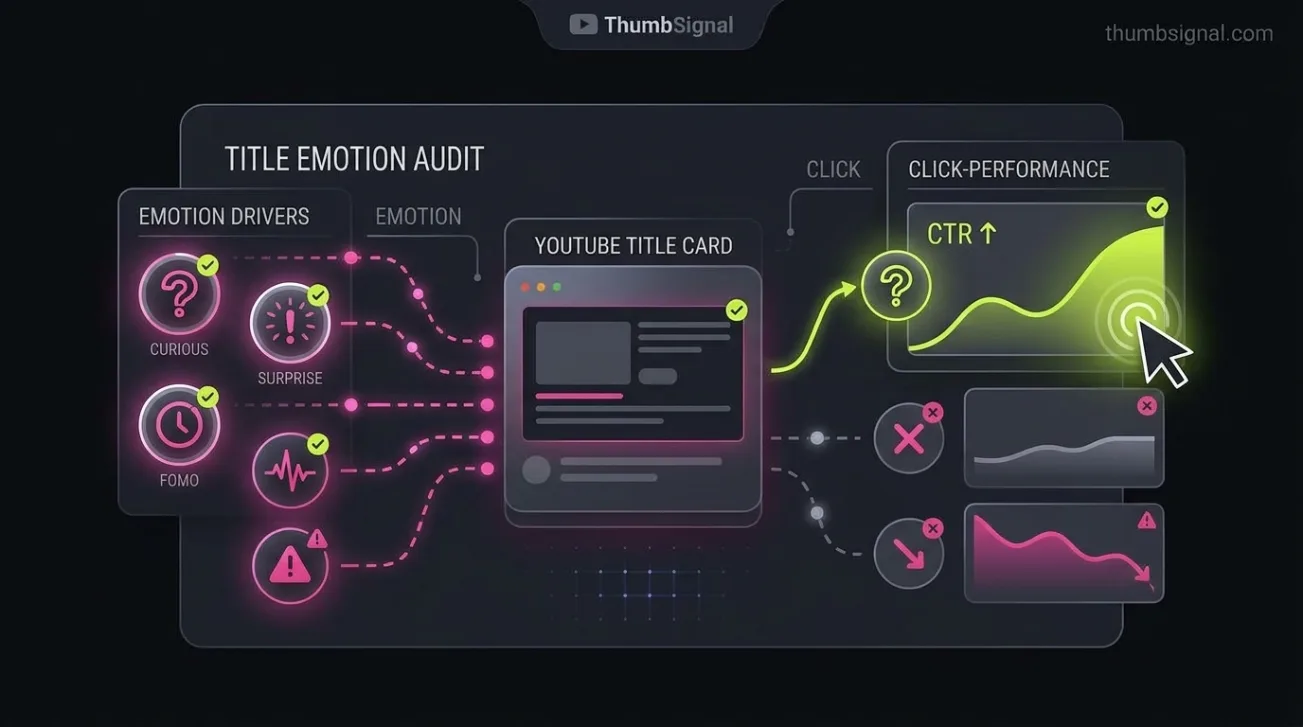
Key takeaways
- Emotional titles work best when the emotion matches the video’s actual content — mismatched emotion kills retention.
- Curiosity, urgency, and relief are often more effective than fear or outrage for informational content.
- Emotion in the title should complement, not duplicate, the thumbnail — each should carry half the emotional weight.
- Not every video needs an emotional title; neutral titles can outperform when the topic demands credibility or precision.
- Emotional intensity without relevance feels manipulative — viewers click once, then bounce, hurting your channel’s long-term performance.
How emotional YouTube titles actually earn clicks — without misleading viewers
Emotional YouTube titles earn clicks by triggering a visceral reaction — but only if the emotion matches what the video delivers. A title that promises outrage but delivers a calm tutorial will lose viewers fast. The key is emotional relevance, not just intensity. Viewers respond to titles that mirror their current mental state or anticipated payoff, whether that’s curiosity, relief, or urgency — not just shock value.
Many creators assume “emotional” means “dramatic” or “controversial,” but that’s a trap. Emotional titles that mislead may spike initial clicks, but they destroy retention, which YouTube’s system tracks closely. A high click-through rate (CTR) with low watch time signals to YouTube that your content doesn’t satisfy viewers — and your video gets buried. Emotional titles must serve the content, not override it.
Consider this: a video titled “How to Fix a Leaky Faucet in 5 Minutes” is accurate but flat. Rewritten as “Stop That Drip Before It Ruins Your Floor — 5-Minute Fix,” it adds urgency and relief — emotions that align with the viewer’s likely frustration and desire for a quick solution. The emotion is real, not manufactured, and the promise is kept.
Emotional intensity vs. emotional relevance — why one wins every time
Emotional intensity grabs attention, but emotional relevance keeps viewers watching. A title like “This Will Change Your Life Forever” is intense — but if the video is about organizing your desk, the mismatch will cost you retention. Viewers feel tricked, and YouTube’s algorithm notices. Emotional relevance means the emotion in the title reflects the actual experience the viewer will have — whether it’s relief after solving a problem, curiosity about a surprising fact, or urgency to avoid a mistake.
Intensity without relevance feels like clickbait. Relevance without intensity feels boring. The sweet spot is emotional alignment: the title’s emotional tone matches the video’s payoff. For example, a video on “How to Calm a Panic Attack” should use relief or safety as its emotional anchor — not fear or shock. The emotion should mirror the viewer’s desired outcome, not their worst-case scenario.
Test this by asking: “If I clicked this title, what emotion would I expect to feel while watching?” If the answer doesn’t match the video’s tone or content, rewrite the title. Emotional titles are not about manipulation — they’re about resonance.
Which emotions work best for informational content — beyond fear and outrage
Informational content thrives on curiosity, urgency, and relief — not fear or outrage. A title like “You’re Doing It Wrong: The Truth About Protein Shakes” uses outrage, but if the video is a calm, evidence-based breakdown, the mismatch will hurt retention. Instead, try “The Protein Shake Mistake 90% of People Make (And How to Fix It)” — it triggers curiosity and relief without overpromising.
Curiosity works because it taps into the brain’s reward system — viewers want to close the knowledge gap. Urgency works because it implies a cost to inaction — “Fix This Before It’s Too Late” implies a deadline, even if it’s self-imposed. Relief works because it promises a solution to a known pain point — “Finally, a Way to Stop Your Cat From Scratching the Couch.”
These emotions are effective because they’re tied to the viewer’s actual experience. Fear and outrage can work — but only if the video delivers on that emotional promise. For most how-to, tutorial, or explainer content, curiosity, urgency, and relief are safer, more sustainable choices.
Why an emotion mismatched to the video costs retention — and how to fix it
An emotion mismatched to the video costs retention because viewers feel misled. If a title promises shock but the video is calm, or if it promises relief but the video is technical and dry, viewers leave. YouTube’s algorithm tracks watch time, drop-off points, and session duration — all of which suffer when the title and content don’t align. A high CTR with low retention signals low-quality content, and YouTube reduces your reach.
To fix this, audit your titles against your video’s actual tone and payoff. Ask: “What emotion does the viewer feel at the end of this video?” If it’s relief, the title should reflect that. If it’s curiosity, the title should tease the answer without giving it away. If it’s urgency, the title should imply a cost to delaying action.
Here’s a concrete example: a video titled “The Secret to Perfect Pancakes” is vague and flat. Rewritten as “Stop Making Tough Pancakes — This One Trick Guarantees Fluffy Results,” it adds urgency and relief — emotions that match the viewer’s likely frustration and desired outcome. The emotion is real, not manufactured, and the promise is kept.
How emotion in the title should divide the work with the thumbnail
Emotion in the title should complement, not duplicate, the thumbnail — each should carry half the emotional weight. If the thumbnail shows a shocked face, the title shouldn’t also scream “SHOCKING TRUTH!” — that’s redundant. Instead, the thumbnail can show the problem (a broken appliance, a messy kitchen), and the title can promise the solution (“Fix This in 3 Minutes — No Tools Needed”).
The thumbnail should grab attention visually — using color, contrast, and facial expressions. The title should clarify the emotional payoff — using words that trigger curiosity, urgency, or relief. Together, they form a complete emotional package. For example, a thumbnail of a person looking stressed at a cluttered desk, paired with the title “This 10-Minute Hack Cleared My Desk — And My Mind,” creates a cohesive emotional narrative.
Test this by covering the thumbnail and reading the title — does it make sense on its own? Then cover the title and look at the thumbnail — does it convey the emotion? If either fails alone, the pairing is weak. The goal is synergy, not repetition.
When emotional titles don’t outperform neutral ones — and why that’s okay
Emotional titles don’t always outperform neutral ones — and that’s okay. For highly technical, academic, or credibility-driven content, a neutral title can perform better. A video titled “Quantum Computing Explained for Beginners” may outperform “You Won’t Believe How Quantum Computing Works!” because the audience values accuracy over hype. Emotional titles can feel unprofessional or misleading in contexts where trust is paramount.
The key is matching the title’s emotional tone to the audience’s expectations. If your viewers are looking for deep, factual content, an emotional title may feel like a gimmick. If they’re looking for quick fixes or entertainment, emotion can be a powerful tool. There’s no universal rule — test both approaches and measure retention, not just CTR.
Use ThumbSignal’s free thumbnail & title analysis tool to compare emotional and neutral titles for the same video. You’ll often find that the emotional version gets more clicks — but the neutral version gets more watch time. The best title is the one that balances both.
How to rewrite a flat title with emotion — without losing accuracy
Start with a flat title and identify the viewer’s emotional state or desired outcome. Then, rewrite to reflect that emotion — without exaggerating or misrepresenting the content. For example, “How to Use Excel Formulas” is accurate but boring. Rewritten as “Stop Wasting Time on Excel — Master These 5 Formulas in 10 Minutes,” it adds urgency and relief — emotions that match the viewer’s likely frustration and desire for efficiency.
Here’s a step-by-step method:
- Identify the viewer’s pain point or goal — what are they trying to solve or achieve?
- Choose an emotion that aligns with that goal — curiosity, urgency, relief, or safety.
- Rewrite the title to include that emotion — use trigger words like “finally,” “stop,” “fix,” “guaranteed,” or “secret.”
- Test the title against the video — does it promise what the video delivers?
- Pair it with a thumbnail that complements, not repeats, the emotion.
This method ensures the emotion is real, not manufactured — and the title is both clickable and honest.
Related reading
- YouTube Title Study: Curiosity, Clarity, and Clickbait Risk
- Analyse de 500 titres YouTube : Curiosité, clarté, risque clickbait
Frequently Asked Questions
Do emotional titles always get more clicks than neutral ones?
No — emotional titles often get more clicks, but not always. For technical, academic, or credibility-driven content, neutral titles can perform better because they signal accuracy and professionalism. The best title balances clickability with retention, not just CTR.
Can I use fear or outrage in emotional titles without hurting retention?
Yes — but only if the video delivers on that emotional promise. If the title says “This Will Shock You,” the video must contain genuinely surprising or provocative content. Otherwise, viewers feel misled, and retention drops.
How do I know if my emotional title matches my video’s content?
Ask: “What emotion does the viewer feel at the end of this video?” If the title’s emotion matches that outcome, it’s aligned. If not, rewrite the title to reflect the actual payoff — whether it’s relief, curiosity, or urgency.
Should the thumbnail and title use the same emotion?
No — they should complement each other. The thumbnail should grab attention visually, and the title should clarify the emotional payoff. If both use the same emotion, it’s redundant. The goal is synergy, not repetition.
Is it okay to use emotional titles for educational content?
Yes — but choose emotions that match the viewer’s experience. Curiosity, urgency, and relief work better than fear or outrage for most educational content. The emotion should reflect the viewer’s desired outcome, not their worst-case scenario.